

How Many Gallons in a Fuel Tank: A Complete Guide with Calculations & Comparisons
How many gallons in a fuel tank depends largely on the vehicle type, but most standard passenger cars hold between 12 and 16 gallons. This range balances fuel capacity with vehicle weight for efficient driving. Knowing your car’s typical tank size helps estimate your driving range and plan refuels effectively.
Key Takeaways
- Most passenger cars have fuel tanks with a capacity between 12 and 16 gallons.
- The official capacity of a fuel tank accounts for an additional 1 to 2.5 gallons held in reserve that shouldn’t be used under normal driving conditions.
- Calculate tank volume in cubic feet and multiply by 7.48 to convert to gallons.
- Low fuel warning lights usually activate around 1 to 2 gallons remaining in the tank.
- Fuel reserves mean a full tank can hold less usable fuel than its stated capacity.
- Knowing your fuel tank size helps estimate driving range by multiplying capacity by miles per gallon.
How Many Gallons Does a Fuel Tank Typically Hold?
Fuel tank capacity varies widely depending on the type of vehicle due to design, weight, and intended use. Compact cars, designed for fuel efficiency and urban driving, usually hold about 10 to 14 gallons. Mid-size sedans strike a balance with tanks around 14 to 18 gallons, while full-size sedans often carry 16 to 20 gallons to support longer highway driving. Larger vehicles like SUVs and trucks require bigger tanks, ranging from 18 up to 35 gallons or more, as they consume more fuel and often travel farther or tow heavy loads.
The largest tanks are typically found on full-size trucks and SUVs, where space allows and fuel needs are greater. For example, some heavy-duty trucks may have tanks over 35 gallons to meet extended range requirements. The average passenger car normally holds between 12 and 16 gallons, which supports a practical driving range without adding unnecessary weight or bulk.
| Vehicle Type | Typical Tank Size (Gallons) | Cost to Fill at $3.86/gal |
|---|---|---|
| Compact Cars | 10, 14 | $38.60, $54.04 |
| Mid-Size Sedans | 14, 18 | $54.04, $69.48 |
| Full-Size Sedans | 16, 20 | $61.76, $77.20 |
| Compact & Mid-Size SUVs | 13, 17 | $50.18, $65.62 |
| Full-Size SUVs & Trucks | 18, 35 | $69.48, $135.10 |
| Hybrids & PHEVs | 11, 14 | $42.46, $54.04 |
Knowing your vehicle’s fuel tank capacity helps you plan refills, estimate travel range, and budget fuel costs. Larger tanks increase driving range but add weight and usually cost more to fill. Smaller tanks reduce vehicle weight and may be more efficient for city driving but require more frequent stops. For trucks or SUVs that regularly tow or haul, a bigger tank provides convenience and fewer interruptions. Compact cars generally stick with smaller tanks to maintain better fuel economy and lighter weight.
How to Calculate Fuel Tank Capacity from Tank Dimensions
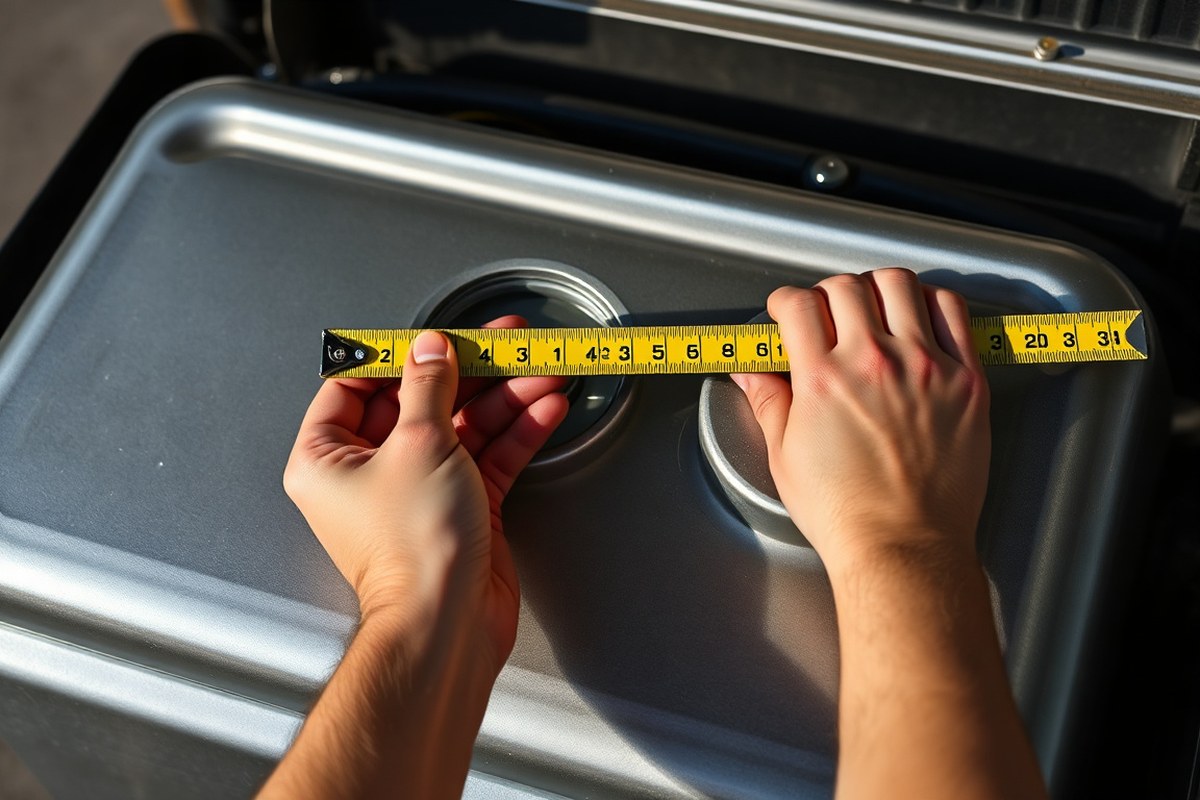
Calculating your fuel tank capacity starts with measuring your tank’s dimensions accurately. You’ll then apply geometric volume formulas depending on its shape and convert the resulting cubic measurements into gallons. This process helps you understand exactly how much fuel your tank holds.
Measuring Length, Width, and Height
Begin by identifying the shape of your fuel tank, common shapes include rectangular (box-like) and cylindrical. For rectangular tanks, measure the internal length, width, and height in inches. These three dimensions reflect the tank’s internal space where fuel sits. For cylindrical tanks, focus on measuring the internal height and the diameter (twice the radius).
Use a rigid tape measure and ensure you measure inside the tank, not the outer shell. Measuring the inside dimensions accounts for the tank material thickness and gives a more accurate volume. Empty the tank before measuring to prevent errors from fuel level.
- Locate the tank’s inside edges to identify length, width, and height (for rectangular) or diameter and height (for cylindrical).
- Use a tape measure to record each dimension to the nearest 1/8 inch for accuracy.
- Take multiple measurements and average them if the tank is irregular or warped.
- Write down the exact measurements before starting your calculations.
- For oval or irregular tanks, measure several cross-sections or ask a professional.
Tip: Always measure from the inside to avoid overestimating your fuel tank’s capacity due to shell thickness.
Common Volume Formulas for Tank Shapes
Each shape uses a specific formula to calculate volume in cubic inches or feet. For a rectangular tank, multiply the length (L), width (W), and height (H) all in inches to get the volume in cubic inches: Volume (cubic inches) = L × W × H A cylindrical tank’s volume calculation uses the radius (r) and height (h). First, find the radius by dividing the diameter by two. Then apply the formula: Volume (cubic inches) = π × r² × h
Oval tanks are more complex. You can approximate them by treating the oval cross-section as an ellipse and multiplying the tank length by the ellipse area (π × semi-major axis × semi-minor axis).
Converting Volume Units to Gallons
Once you have the volume in cubic inches, convert it to gallons using conversion formulas. One US gallon equals 231 cubic inches. Use this formula: Gallons = Volume (cubic inches) ÷ 231 For example, a rectangular tank measuring 24 inches long, 12 inches wide, and 10 inches high has a volume of: 24 × 12 × 10 = 2,880 cubic inches Convert to gallons: 2,880 ÷ 231 ≈ 12.47 gallons This means the tank holds about 12.5 gallons of fuel when full.
For larger volumes or when measurements are in cubic feet, use 1 cubic foot = 7.48 gallons. First convert inches to feet (divide by 12), then multiply length × width × height, then multiply by 7.48.
Understanding Fuel Reserves and Why Full Means Less Than Stated
Your vehicle’s fuel tank capacity usually includes a fuel reserve that holds between 1 and 2.5 gallons of gas. This reserve is not meant to be used during routine driving or refueling but serves an important role in protecting components like the fuel pump. For example, if your car’s total capacity is 15 gallons, approximately 1.5 to 2.5 gallons remain as a reserve tucked away at the bottom of your tank. This reserve means that when your fuel gauge reads “empty” and the low fuel light illuminates, there is still fuel left in the tank, enough to prevent you from stalling immediately but not advisable to rely on regularly.
The fuel gauge in your car usually shows a drop from full to empty, with a “reserve zone” near the bottom representing this amount of fuel left after the low fuel warning activates. You can think of this zone as a buffer: once your needle hits the reserve or the low fuel light comes on, your car still holds gas but it’s time to head to a gas station soon. Typically, the low fuel light triggers when roughly 1.5 to 2.5 gallons remain, depending on tank size and design. This warning helps prevent your fuel pump from overheating by keeping it submerged in fuel, which is critical for its longevity.
Your fill-up might take less gas than the tank’s official capacity because the reserve fuel space is not accessible during refueling. This space may also include slight allowances for expansion, evaporation controls, or tank shape irregularities. Also, the fuel nozzle automatically shuts off once the tank reaches a safe pressure level to avoid spills or overfilling, which means the entire volume is rarely filled to the exact rated capacity during a typical fill-up. For example, if your tank is rated at 15 gallons but your pump stops at 13.5 gallons, the difference often reflects this reserve and safety margin.
To estimate your usable fuel capacity and identify your reserve, fill the tank completely and note the gallons added. Drive normally until your low fuel light comes on, then record the miles driven after the light activated. If your car gets 30 miles per gallon and you can drive about 45 miles before running out, that suggests roughly 1.5 gallons remain in reserve. This practical test can help you understand how much fuel you actually have to work with and plan refueling stops more accurately.
Different vehicles may vary in reserve size depending on tank shape, fuel pump design, and manufacturer preferences. Large trucks or vehicles with auxiliary tanks may have larger reserves or multiple fuel warnings. Knowing your car’s reserve helps you avoid unexpected stalls and maintain fuel pump health by not running the tank too low. This simple knowledge can save you from inconvenient breakdowns and ensure your gauge and fill-ups match your actual driving needs.
Using Fuel Tank Inches to Gallons Charts and Tools
A fuel tank inches to gallons chart helps you convert the depth of fuel measured inside your tank into an exact number of gallons. These charts simplify fuel management by turning dipstick readings, taken in inches, into volume estimates so you can know how much fuel remains. Using these charts or online tools lets you plan refueling without guessing.
Reading Inches to Gallons Charts
Fuel tank charts list various fuel depths in inches alongside their corresponding volume in gallons. Each row shows how many gallons correspond to a certain measured depth, typically starting from empty (0 inches) up to full (the tank’s maximum depth). By matching your measured fuel depth to the chart, you find how many gallons are in the tank.
For example, if your tank’s max depth is 12 inches and the chart shows that 6 inches corresponds to 7.5 gallons, then a 6-inch fuel depth means you have roughly 7.5 gallons of fuel left. These charts are often customized for a particular tank size and shape to improve accuracy.
| Fuel Depth (inches) | Fuel Volume (gallons) |
|---|---|
| 0 | 0.0 |
| 2 | 2.5 |
| 4 | 5.0 |
| 6 | 7.5 |
| 8 | 10.0 |
| 10 | 12.5 |
| 12 | 15.0 |
Charts like these can be printed or viewed digitally, and some offer rows for every half inch for more precision. Having this on hand speeds up checking fuel levels accurately.
Measuring Fuel Depth Accurately
Use a clean, long dipstick to measure your fuel depth inside the tank. Insert the stick vertically until it touches the bottom, then mark or note the wet point where it meets the fuel surface. Clean the stick before each measurement for consistent results.
Taking this measurement requires some care: avoid tilting the stick and try to measure with the vehicle parked on level ground. These factors help ensure you don’t over or understate the fuel level. Use the nearest inch or half inch to match with your chart.
- Obtain a suitable dipstick, one long enough to reach the bottom of your tank.
- Make sure the vehicle is parked on level ground and the engine is off.
- Insert the dipstick vertically into the fuel filler opening until it touches the tank’s bottom.
- Pull the dipstick out carefully, keeping it level, and note the wet mark.
- Clean the dipstick before making further measurements for accuracy.
- Consult your inches to gallons chart to convert the measured inch reading into gallons.
Top Online Fuel Tank Calculators
Several online calculators generate customized fuel tank conversion charts or printables for your tank size. These tools ask for tank dimensions, height, diameter, or length, and output a dipstick chart matching inches to gallons. This saves time and ensures you get precise conversions tailored to your tank.
Popular options include dip chart generators where you enter your tank’s dimensions, then receive a printable chart or a dipstick template scaled 1:1 with gallon markings. Some calculators also provide charts for common tank shapes and automotive fuel tanks. Example websites offering such tools typically include:
- Tank Volume Calculator: Enter height and width, then print an inches-to-gallons chart customized to your inputs.
- Printable Dipstick Maker: Upload your tank size to get a dipstick scale marked directly in gallons for quick measuring on the go.
- Fuel Tank Volume Calculator: Converts any measured inch level into gallons and vice versa, useful for fuel management planning.
Using these tools requires basic tank measurements and free downloadable or printable results. They work well for automotive tanks, helping drivers know exactly how much fuel is inside based on stick readings.
How to Find Your Exact Fuel Tank Size Without Measuring
You can find your vehicle’s exact fuel tank capacity most reliably by consulting the owner’s manual, decoding the Vehicle Identification Number (VIN), or checking official manufacturer resources online. These methods provide factory specifications that match your specific model and year, offering accuracy that generic estimates or guesses cannot match.
Checking the Owner’s Manual
The owner’s manual is the first place to check for your car’s fuel tank size. Look under the “Specifications” section where the manufacturer lists detailed information, including the exact gallon capacity of the tank. This figure reflects the design set during manufacturing, making it very accurate for your vehicle.
If you don’t have a physical manual, you can usually find a digital copy by searching online for “[Your Car Model] [Year] owner’s manual PDF.” Manufacturers often provide these files for free. Using the manual gives you certainty about your tank size without needing guesswork or additional tools.
Using the Vehicle Identification Number (VIN)
Your VIN is a unique 17-character code assigned to your vehicle at the factory. It contains detailed information about the car’s build, including trim, engine, and sometimes fuel tank capacity. Free VIN decoder tools online allow you to input this code and access these details. Follow these simple steps to use a VIN decoder:
- Locate your VIN, check the driver’s side dashboard or inside the driver’s door frame.
- Go to a trusted VIN decoder website, such as the National Highway Traffic Safety Administration’s VIN lookup tool or commercial services offering free reports.
- Enter your 17-character VIN accurately.
- Review the vehicle’s specifications provided, looking specifically for fuel tank capacity or related information.
While VIN decoders focus more on vehicle history and general specifications, many include fuel tank size because it matters for maintenance and resale. The accuracy depends on the database’s completeness, but official or well-known decoders are reliable.
Use the exact VIN found on your vehicle’s metal plate or registration documents; small errors can lead to incorrect or incomplete data.
Consulting Manufacturer and Online Resources
Manufacturer websites often share detailed specifications for each model year. By entering your car’s make, model, and year, you can find factory specs including fuel tank size. This source confirms the data you’ll find in manuals or from the VIN.
Other online databases focused on vehicle specs also compile fuel tank capacities. You can compare information from several sources to ensure accuracy. However, beware of user-submitted data or sites without clear reference, they may contain inconsistencies.
- Check official manufacturer or dealership websites for specs.
- Use trusted automotive databases or services that specialize in vehicle data.
- Cross-reference specs if uncertain, focusing on original factory numbers.
- Look for stickers inside the fuel door as sometimes tank size is printed there.
- Avoid estimates from informal forums or non-specialist sites without citations.
Official and manufacturer-produced resources give you the confidence that the fuel tank size you obtain matches your exact vehicle configuration. This is especially important if you own a vehicle with multiple options or fuel system variations.
How Fuel Tank Size Affects Driving Range and Fuel Costs
Your vehicle’s fuel tank size directly influences how far you can drive before needing to refuel, and it also affects your fueling expenses. To estimate your driving range, multiply the tank capacity (in gallons) by your vehicle’s fuel efficiency, usually measured in miles per gallon (MPG). For example, if your car has a 15-gallon tank and gets 30 MPG, you can expect a driving range of 450 miles before the tank runs dry.
Fueling costs vary depending on both the size of your tank and the current price of fuel. For instance, filling a 15-gallon tank at a fuel price of $4.00 per gallon would cost $60. On the other hand, a 20-gallon tank at the same price would cost $80 to fill. Knowing your tank capacity and fuel prices helps you budget for fuel expenses more accurately.
Bigger tanks do not always guarantee more range because range depends on fuel efficiency as well. Larger, heavier vehicles often have bigger tanks but lower MPG, so their range may be similar or even less than smaller vehicles with smaller tanks but higher fuel efficiency. For example, a truck with a 25-gallon tank but an MPG of 15 has a range of 375 miles, which is less than the car with 15 gallons and 30 MPG.
To understand how tank size affects total fuel cost, consider these examples at a fuel price of $3.50 per gallon: a 12-gallon tank fills for $42, a 16-gallon tank for $56, and a 20-gallon tank for $70. If your vehicle averages 25 MPG, these tanks give driving ranges of 300, 400, and 500 miles respectively.
Tracking these numbers helps you plan trips, decide when to refuel, and manage your fuel budget. Larger tanks reduce the frequency of stops on long trips, but you pay more each time you fill up. Smaller tanks mean lower fill-up costs but more frequent stops. Your fuel costs over time depend on driving habits, fuel efficiency, and gas prices, not just tank size.
To estimate your trip’s fuel requirement, divide the total miles you plan to drive by your vehicle’s MPG to find gallons needed. Multiply that by current fuel price to get your cost. For example, a 300-mile trip at 30 MPG requires 10 gallons. At $3.80 per gallon, that trip costs $38 in fuel.
Common Mistakes and Myths When Measuring Fuel Tank Capacity
Errors in figuring out fuel tank capacity often come from basic measurement mistakes and misunderstanding what the numbers really mean. One common issue is measuring the tank’s outer dimensions and assuming that equals the inside volume. The thickness of the tank walls can reduce the effective volume by several percent, especially in smaller tanks where a half-inch of tank material forms a bigger portion of the total space. Using external dimensions without accounting for this leads to an overestimate of how much fuel the tank can hold.
Another frequent mistake is mixing volume and weight. Some try to estimate gallons based on the weight of the fuel they pour in, but this can fluctuate because fuel density varies by temperature and fuel type. Density details are important for weight-based calculations but irrelevant if you’re measuring volume directly. For volume, stick with dimensions or manufacturer specifications.
- Measuring external tank size instead of internal dimensions
- Ignoring tank wall thickness and fittings inside the tank
- Confusing fuel weight with volume and neglecting density changes
- Applying averages on irregularly shaped tanks without segmenting the measurement
- Relying on myths about bigger tanks improving fuel economy
- Not consulting manufacturer guides or official specs
Myths around fuel tank size can also lead to wrong assumptions. One is the belief that a bigger tank somehow improves fuel efficiency by reducing trips to the pump. In fact, tank size has no effect on how efficiently your engine uses fuel. Fuel economy depends on engine design, driving conditions, and vehicle weight, but the amount of fuel carried does not increase miles per gallon. Larger tanks provide longer driving range but can add weight, which might slightly reduce efficiency.
To avoid common pitfalls, measure tank dimensions internally, check if the manufacturer offers detailed specs, and focus on volume rather than weight. Use a measuring tape to record length, width, and height inside the tank, then subtract about a quarter inch for tank wall thickness on each side, if you can’t measure that directly. For irregular shapes, break the tank down into simple geometric sections and measure those individually before adding them up. Always compare your calculations with the manufacturer’s listed capacity when available, as this accounts for real-world tank shapes and internal components.
Special Cases: Auxiliary Tanks, Semi-Trucks, and Hybrid Vehicles
Adding an auxiliary fuel tank is common for pickup trucks and large SUVs to extend driving range without frequent refueling stops. These tanks connect to the vehicle’s main tank and use pumps or gravity feed systems to supply fuel to the engine. Installation must include proper fuel lines, mounting brackets, and sometimes upgraded fuel pumps to handle the additional tank. This setup is especially helpful for off-road drivers or those traveling in remote areas where fuel stations are scarce.
| Tank Type | Typical Size (Gallons) | Common Uses | Installation Factors |
|---|---|---|---|
| Standard Fuel Tank (Passenger Cars) | 12, 20 | Daily driving, commuting | Factory installed, sealed unit |
| Auxiliary Fuel Tank | 10, 40 | Extended range, off-road, remote travel | Custom installation, requires fuel lines and pumps |
Auxiliary tanks need professional installation to avoid leaks or fuel delivery problems. Costs range from $500 to over $2,000 depending on tank size and complexity. Improper installation may cause fuel contamination or engine issues, so follow local laws and have a certified mechanic perform the work.
Semi-trucks typically have much larger fuel tanks than passenger vehicles due to their weight and long-haul needs. Most semi-trucks have dual tanks located on either side, with a total capacity between 100 and 300 gallons. This capacity supports trips of several hundred miles without refueling, important for freight routes crossing rural areas or highways without frequent fuel stops.
Hybrid vehicles and plug-in hybrids (PHEVs) often have smaller fuel tanks. Since part of their power comes from electric motors and batteries, they don’t rely solely on gasoline. Gas tanks in PHEVs usually range from 8 to 12 gallons, smaller than comparable non-hybrid models. This reduced size helps save weight and space, improving overall fuel efficiency and allowing for the battery pack.
Practical tip: When adding an auxiliary fuel tank, make sure to check your vehicle’s warranty and local regulations to avoid legal or mechanical issues.
Step-by-Step Action Plan for Knowing Your Fuel Tank Capacity
Follow these practical steps to quickly find out exactly how many gallons your vehicle’s fuel tank holds and confirm it accurately.
- Before you start: Locate your vehicle’s manual or look up the make, model, and year online to find the official fuel tank capacity. Verify the number matches typical figures for your vehicle type.
- Day 1: Check your fuel gauge and fill the tank until the pump automatically stops. Record the number of gallons pumped. This gives a practical capacity, including the reserve.
- Day 2: Use a measuring tape to find your tank dimensions (length, width, height) if possible. Apply the calculation method for volume or use a fuel tank inches to gallons chart available online to estimate capacity yourself.
- Day 3: Consider any auxiliary tanks or special modifications that may increase your fuel total. Confirm these with vehicle documentation or physically inspect these tanks.
- After 1 week: Compare the manual capacity, pump fill gallons, and your measurement results. They should be close within 5-10%. If not, review each step for errors or possible fuel stuck in lines/reserves.
- After 2 weeks: Monitor your driving range and fuel costs relative to your tank size. Adjust your fuel planning to avoid running low unexpectedly and optimize fill-ups based on your confirmed tank volume.
Frequently Asked Questions
What Factors Affect How Many Gallons Your Fuel Tank Can Hold?
Tank size depends on vehicle type, design needs, and fuel range preferences, which vary widely between compact cars and trucks. Weight limits and available space also influence fuel tank capacity.
Can Filling Your Tank Completely Damage the Fuel System?
Filling beyond the tank’s capacity can cause overflow or damage the evaporative emission system. Most vehicles are designed to prevent overfilling.
Does Altitude Change How Much Fuel Your Tank Can Hold?
Altitude does not change physical tank capacity but can slightly affect fuel evaporation and pressure.
How Does Fuel Temperature Affect Tank Capacity Readings?
Fuel expands when warm, so measured volume can vary slightly with temperature. This doesn’t change tank size but affects fuel quantity by volume.
Are Diesel Fuel Tanks Sized Differently from Gasoline Tanks?
Diesel tanks often hold more fuel than gasoline tanks to support longer routes and heavier engine loads, especially in trucks.
How Much Fuel Do Electric Hybrid Cars Store Compared to Gasoline Cars?
Hybrid cars usually have smaller fuel tanks around 7 to 10 gallons due to their electric motor assistance.
Key Points to Remember
Knowing exactly how many gallons your fuel tank holds helps you plan refueling and understand your vehicle’s range better. Start by checking your manual or filling up and measuring the fuel added. Use simple dimension checks and conversion charts to double-check if needed. Take action today by locating your vehicle’s official capacity to increase your confidence on the road.