Why Won’t My Jeep Start and How to Fix It
Your Jeep won’t start likely due to a weak battery, low fuel, a faulty starter, or electrical issues. First, check that your battery voltage is around 12.6V and that terminals are clean.
Make sure you have enough fuel and listen for the fuel pump humming when you turn the key.
Also, verify the vehicle’s in Park or Neutral and try turning the steering wheel while starting.
If it still won’t start, more detailed steps can help identify the exact cause.
Key Takeaways
- Check battery voltage (should be ~12.6V) and terminals for corrosion or looseness to ensure proper electrical power.
- Listen for starter clicking and test voltage at solenoid to diagnose starter or ignition switch failures.
- Verify Jeep is in Park or Neutral to rule out neutral safety switch preventing start.
- Confirm fuel availability, listen for fuel pump humming, and test fuel pressure to ensure proper fuel delivery.
- Use an OBD-II scanner to identify engine or sensor faults and seek professional help if problems persist.
Quick Troubleshooting Steps to Get Your Jeep Started
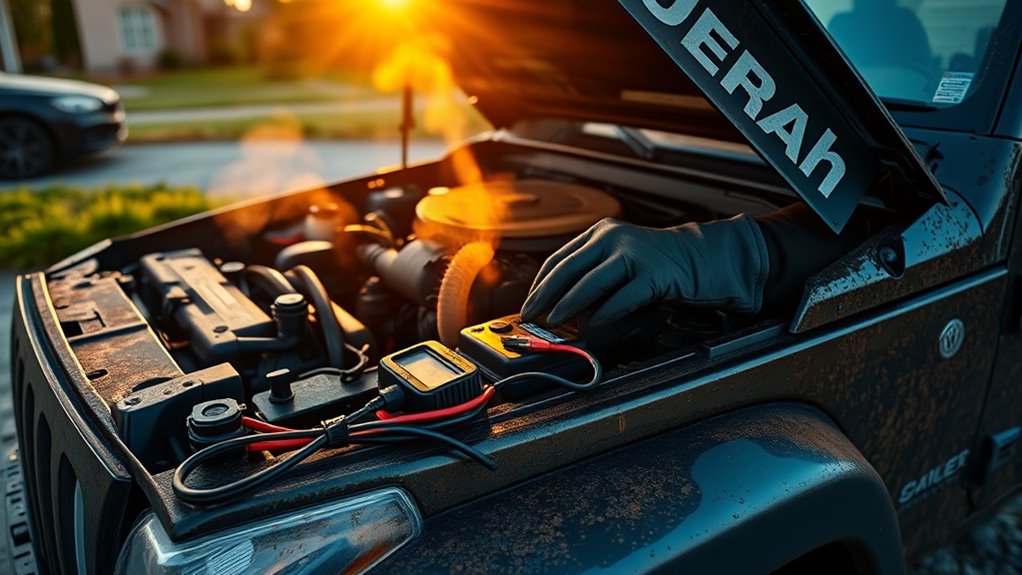
Before diving into complex repairs, start by checking your Jeep’s battery voltage with a multimeter. It should read around 12.6V when the vehicle is off. A weak battery often causes starting problems, so make sure the terminals are clean and tight.
Begin troubleshooting by measuring your Jeep’s battery voltage; a healthy battery reads about 12.6V when off.
Next, turn the key and listen for a clicking sound. If you hear it, the starter motor is trying to engage. If not, the starter or ignition switch could be faulty.
Also, verify your Jeep is in Park or Neutral, as a bad neutral safety switch can prevent the engine from cranking. To rule out fuel delivery issues, turn the key to the “On” position and listen for the fuel pump humming.
If you don’t hear it, the fuel pump or related components might be the problem. These quick checks help you pinpoint whether the battery, starter, ignition switch, or fuel delivery system is causing your Jeep not to start.
How to Check Your Jeep’s Fuel Level Before Starting
Before you start your Jeep, take a quick look at the fuel gauge on your dashboard to see how much gas is left. If the needle is close to “E” or if the fuel warning light comes on, that means you’re running low and should plan to refuel soon. It’s also helpful to have a sense of your usual fuel consumption so you can guess how far you might still be able to drive before running out.
Understanding The Fuel Gauge
How can you tell if your Jeep has enough fuel to start? The answer lies in the fuel gauge on your dashboard. This gauge shows the fuel level with a needle pointing from “F” for full to “E” for empty.
If the needle is close to “E,” your Jeep is running low. This might cause starting issues due to an empty tank or insufficient fuel supply. Many drivers overlook the fuel gauge, but checking it before you start can save you from getting stranded.
Some Jeep models also feature a low fuel warning light that activates when fuel drops below 10-15%. Regularly monitoring your fuel gauge and refilling before it hits “E” helps ensure your Jeep starts reliably every time.
Recognizing The “E” Warning
When the “E” warning lights up on your Jeep’s dashboard, it signals that your fuel is critically low. This warning sign means your fuel gauge is pointing near empty, and you need to act before starting your engine.
Ignoring low fuel can lead to starting problems because your Jeep might not have enough gas to turn over. Always check the fuel gauge before you start driving to avoid unexpected stalls or no-start situations.
If you see the “E” warning, don’t wait. Fill up your tank as soon as possible. Keeping an eye on these warning signs guarantees your Jeep starts smoothly and prevents the inconvenience of running out of fuel when you least expect it.
Estimating Remaining Driving Range
Although your Jeep’s fuel gauge gives a quick snapshot of fuel levels, estimating the remaining driving range helps you plan ahead and avoid unexpected stops. Check the fuel gauge on your dashboard to see the current fuel level, and watch for the “E” warning light signaling critically low remaining miles.
Many Jeeps display an estimated remaining driving range based on recent fuel consumption, giving you a clearer idea of how far you can go. To improve accuracy, reset your trip odometer after each fill-up, then track your fuel efficiency over time.
Diagnosing Battery Problems That Stop Your Jeep
Since the battery powers all the electrical systems in your Jeep, a weak or dead battery often causes starting issues. If you notice dimming lights, slow engine cranking, or no response when you turn the key, your battery might be the culprit.
A weak or dead battery often causes starting problems like dimming lights and slow engine cranking.
Corrosion or loose connections at the battery terminals can also interrupt power flow, preventing the ignition switch from sending the start signal. To diagnose battery problems, check for these signs and test the battery voltage with a multimeter. Healthy batteries show about 12.6 volts.
Here’s what to look for:
- Dimming dashboard or headlights during starting attempts
- Slow or labored engine cranking
- Corroded or loose battery terminals
- Voltage readings below 12.4 volts
If jump-starting works temporarily, consider replacing the battery to avoid repeated starting failures. Cleaning corrosion and tightening terminals often restores power flow, but an old battery over five years old usually needs replacement.
How to Unlock a Locked Jeep Steering Wheel
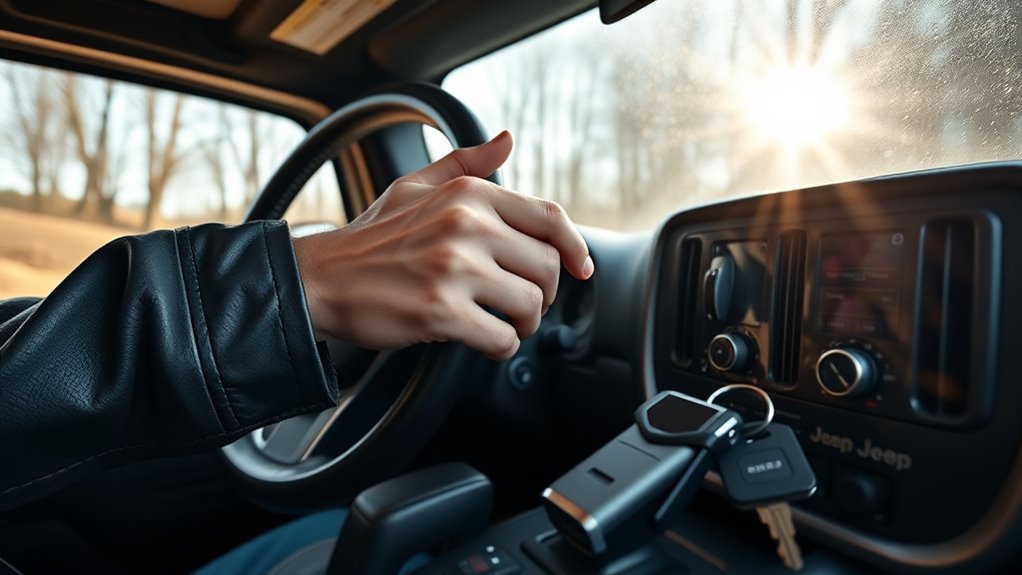
If your Jeep’s steering wheel locks, you can usually free it by gently turning the wheel left and right while turning the ignition key. First, make sure the ignition key is fully inserted and turned to the “On” or “Start” position as you move the steering wheel.
If the wheel is stiff, apply steady pressure while turning the key to unlock the steering lock mechanism. Some Jeep models include a manual override or release button near the steering column, which you can use to unlock the wheel.
Avoid forcing the wheel or ignition key excessively to prevent damage.
| Action | Purpose |
|---|---|
| Turn steering wheel left and right | Relieves pressure on lock mechanism |
| Insert and turn ignition key fully | Engages ignition to unlock wheel |
| Use manual override button (if available) | Bypasses lock for easy unlocking |
This method helps you unlock the steering wheel safely and get your Jeep started.
How to Test If Your Jeep’s Starter Motor Is Faulty
When your Jeep won’t crank and you hear a clicking sound, the starter motor might be the culprit. To test if your starter motor is faulty, start by performing a voltage test at the starter solenoid while trying to start the Jeep. If you don’t see voltage, the issue is likely wiring or relay-related, not the starter itself.
If voltage is present, but the engine won’t turn over, your starter motor may be stuck or faulty.
Here’s how to check your starter motor:
Use a multimeter to measure voltage at the starter terminal during startup attempts; readings below 9V indicate a problem.
Listen for a clicking sound when turning the key, a common sign of a faulty starter motor.
Lightly tap the starter with a hammer while trying to start; if it cranks afterward, the starter is failing.
If the starter remains unresponsive despite proper voltage, it needs replacement.
How to Check the Ignition Switch for Starting Problems
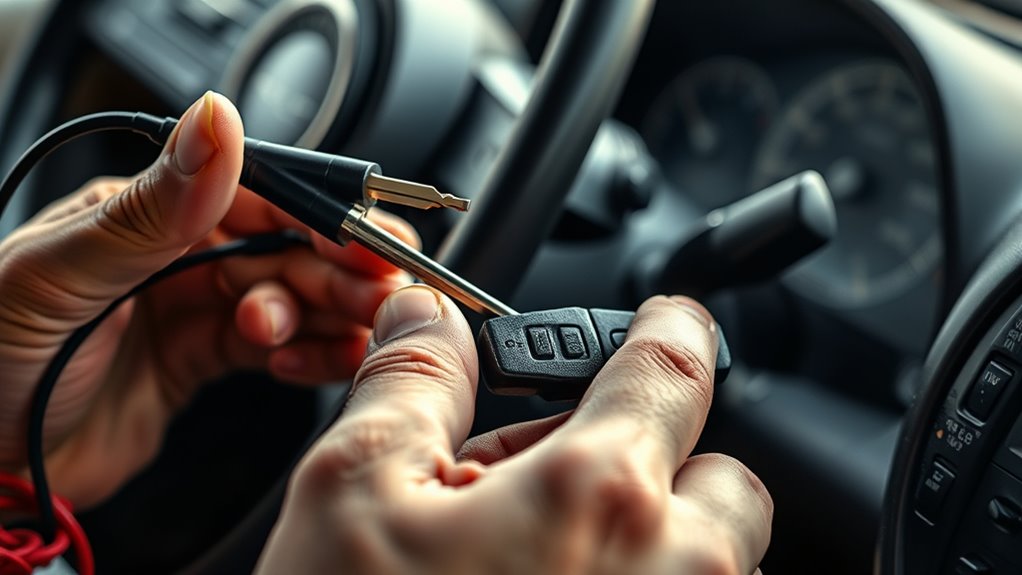
After ruling out the starter motor as the cause of your Jeep’s starting issues, the ignition switch is the next component to examine. To check for starting problems, first turn the key to the “On” position. If the dashboard lights don’t illuminate properly, the ignition switch may be faulty.
Next, use a multimeter to test the ignition switch for continuity between terminals when the key is turned to “Start.” Listen for any unusual clicking or resistance, which can indicate wear. Also, try starting with a spare key to rule out key recognition issues.
If the engine still won’t respond, remove the ignition switch to inspect for damage.
| Step | What to Do | What It Indicates |
|---|---|---|
| Turn key to “On” | Check dashboard lights | Ignition switch may work or fail |
| Test with multimeter | Check continuity on terminals | Confirms electrical function |
| Listen while turning key | Detect clicking or resistance | Possible mechanical wear |
| Use spare key | Attempt to start vehicle | Rules out key-related problems |
How to Diagnose and Fix Jeep Fuel Delivery Issues
Because your Jeep relies on a steady fuel supply to start, diagnosing fuel delivery issues is essential when the engine won’t turn over. Start by checking the fuel filter; a clogged one can block fuel flow, so replace it regularly to maintain proper fuel delivery.
A steady fuel supply is crucial; check and replace the fuel filter if your Jeep won’t start.
Next, listen for a humming sound from the fuel pump when you turn the ignition to “On.” If you don’t hear it, the pump or its fuse might be faulty. Testing fuel pressure with a gauge on the fuel rail confirms if the system delivers enough pressure.
Also, inspect the fuel lines for leaks, damage, or blockages that could disrupt fuel delivery.
To diagnose and fix fuel delivery issues, focus on:
- Replacing the fuel filter
- Checking the fuel pump operation
- Testing fuel pressure with a gauge
- Inspecting fuel lines for damage or leaks
Addressing these steps will help get your Jeep running smoothly again.
How the Neutral Safety Switch Affects Jeep Starting
The neutral safety switch is there to make sure your Jeep only starts when it’s in park or neutral, which helps keep things safe. So, if your Jeep won’t start but you know the battery and starter are working fine, this switch could be the problem.
You can test the switch yourself or have it replaced. A common sign is when your Jeep starts in neutral but not in park—then you know the neutral safety switch might need some attention.
Neutral Safety Switch Function
Although it might seem simple, the neutral safety switch plays a crucial role in your Jeep’s starting system by preventing the engine from starting unless the transmission is in park or neutral. This safety feature stops accidental starts in gear, protecting both you and your vehicle.
If the neutral safety switch malfunctions, it can break the electrical circuit needed to start the engine, causing starting issues even when the transmission position is correct.
Here’s what you should know about the neutral safety switch function:
- Ensures the engine only starts in park or neutral
- Interrupts the electrical circuit if transmission isn’t in the right position
- Can wear out internally, leading to inconsistent starts
- Replacement often fixes transmission-related starting problems
Diagnosing Switch Malfunctions
When your Jeep won’t start, a faulty neutral safety switch might be the culprit, especially if the engine cranks but doesn’t fire up or refuses to crank at all. The neutral safety switch prevents the engine from starting unless the transmission is in park or neutral, so a switch malfunction can cause these starting issues.
Testing the switch is straightforward: shift your Jeep through park and neutral, then try starting it in each position. If it only starts in one gear or not at all, the neutral safety switch likely needs adjustment, repair, or replacement.
You can also temporarily bypass the switch to confirm if it’s causing the problem. Addressing the neutral safety switch guarantees your Jeep starts safely and reliably every time.
How to Check Wiring and Electrical Connections
If your Jeep won’t start, checking the wiring and electrical connections can often reveal the problem. Start by inspecting the battery cables and wiring for corrosion, loose ends, or visible damage. Corrosion can block proper electrical flow, so clean any buildup you find.
Next, verify all wiring connectors around the starter, ignition switch, and fuse box are firmly seated and free of corrosion. Damaged or frayed wiring insulation can cause shorts or intermittent power loss, so look closely for any signs of wear.
While testing, gently wiggle the wiring and connectors to spot loose or faulty connections that might disrupt power delivery.
Here’s what to focus on:
- Inspect battery cables for corrosion and looseness
- Check wiring connectors near the starter and fuse box
- Look for damaged or frayed insulation on wiring
- Wiggle wires gently to find intermittent connection issues
These steps help you pinpoint wiring and electrical connection problems that prevent your Jeep from starting.
Using Diagnostic Tools to Pinpoint Jeep Starting Faults
Since modern Jeeps rely heavily on electronics, using diagnostic tools is essential to quickly identify starting faults. You can use an OBD-II scanner to read error codes from the engine control unit, revealing issues with sensors or the electrical system. A multimeter helps you measure voltage at vital points like the battery and starter, pinpointing electrical faults.
Code readers detect problems in fuel or position sensors, which often cause no-start conditions. Advanced diagnostic software offers real-time data during engine cranking, catching intermittent faults.
| Diagnostic Tool | Purpose |
|---|---|
| OBD-II Scanner | Reads error codes for engine/sensor faults |
| Multimeter | Measures voltage in battery and starter |
| Code Reader | Detects fuel system and sensor issues |
| Wiring Tester | Checks continuity of wiring and relays |
| Diagnostic Software | Provides real-time data during cranking |
Using these diagnostic tools, you’ll efficiently isolate electrical and sensor-related starting faults, saving time and effort.
When to Replace Jeep Starting Parts or Call a Mechanic
Although diagnosing Jeep starting issues can be straightforward with the right tools, knowing when to replace parts like the starter motor, battery, or ignition switch is essential to restoring reliable engine cranking. You should replace your starter if it clicks but the engine won’t turn over after several tries.
Swap out the battery if it’s older than five years, corroded, or fails voltage tests. A loose or unresponsive ignition switch, especially paired with electrical problems, also calls for replacement.
Here’s when to contemplate part replacement or call for professional help:
- Starter clicks without engine turnover after multiple attempts
- Battery shows corrosion, age over five years, or low voltage
- Ignition switch feels loose or doesn’t engage properly
- Persistent starting problems despite new parts, indicating wiring or sensor faults
If complex wiring issues or error codes persist, don’t hesitate to seek professional help to avoid misdiagnosis and ensure proper repair.
Jeep Preventative Maintenance Tips to Avoid Starting Problems
You’ll want to keep your battery terminals clean and free of corrosion to make sure your Jeep starts up without any issues. Also, don’t forget to replace your fuel filter on time—this helps keep the fuel flowing properly. By taking these simple steps, you can easily avoid those common starting problems that can be such a hassle.
Battery Care Essentials
How often do you check your Jeep’s battery? Proper battery care is vital to avoid starting problems. Make certain to regularly inspect and clean your battery terminals to prevent corrosion, which can block electrical flow.
Keep an eye on battery voltage with a multimeter; a healthy battery reads about 12.6 volts when off. Also, verify battery cables are tight and free from dirt or corrosion to maintain peak power delivery.
Here’s how to keep your battery in top shape:
- Clean battery terminals to prevent corrosion buildup
- Check battery voltage regularly with a multimeter
- Inspect and tighten battery cables for secure connections
- Replace the battery every 3 to 5 years for reliable starts
Following these steps will keep your Jeep starting strong.
Fuel System Maintenance
Why does your Jeep sometimes struggle to start even when the battery is in good shape? Often, the issue lies within the fuel system. Regularly replacing the fuel filter every 20,000 to 30,000 miles is essential to prevent clogging that restricts fuel flow and causes startup problems.
You should also use high-quality fuel and avoid stale or contaminated gas to maintain proper combustion. Inspecting fuel lines for leaks and keeping them clean ensures consistent fuel delivery.
Don’t overlook the fuel pump. Periodic checks and maintenance can prevent failure and unreliable starts. Monitoring fuel pressure with a gauge helps catch early signs of fuel system trouble before they escalate.
Taking these steps keeps your fuel system in top shape and your Jeep starting smoothly every time.
Frequently Asked Questions
Can Extreme Weather Affect My Jeep’s Ability to Start?
Yes, extreme weather can definitely affect your Jeep’s ability to start. Cold can cause battery corrosion, reducing its power. It may also lead to fuel pump failure by thickening fuel or clogging filters.
Starter motor issues often arise because cold makes engine parts stiff. Spark plug problems can happen due to moisture or frost. Regular maintenance and checking these components can help you avoid starting troubles in harsh weather.
How Does a Faulty Key Fob Impact Jeep Starting?
Imagine trying to start your Jeep, but the engine stays silent, like a stubborn door refusing to budge. That’s often remote key issues at play. A faulty key fob can cause battery signal problems or key fob interference.
These electronic malfunctions prevent your Jeep’s immobilizer from recognizing the key, stopping the engine from turning over. You’ll need to check or replace the key fob battery, or even reprogram it to get your Jeep roaring again.
Why Does My Jeep Start Sometimes but Not Always?
Your Jeep starts sometimes but not always because battery corrosion can interrupt electrical flow, making power delivery inconsistent. A faulty ignition switch might not send power to the starter every time.
If the fuel pump isn’t working properly, it can cause inconsistent fuel delivery, preventing starts. Worn or fouled spark plugs may fail to ignite the fuel-air mixture reliably.
Checking and fixing these parts can restore dependable starting.
Can Aftermarket Modifications Cause Jeep Starting Issues?
Absolutely, aftermarket modifications can cause Jeep starting issues. Imagine your Jeep hesitating or refusing to start. Aftermarket parts like ignition system upgrades or battery upgrades might be the culprit.
Even exhaust modifications, though less obvious, can affect engine performance and startup. If these parts aren’t compatible or properly installed, they can disrupt your Jeep’s electrical flow or sensor signals, leaving you stranded.
Always double-check your mods to avoid unexpected starting problems.
What Role Does the Engine Immobilizer Play in Starting Problems?
The engine immobilizer plays a vital role in your Jeep’s starting problems by acting as part of the security system. If it fails to recognize your key due to signal interference or a key recognition issue, it disables the starter motor.
You might see the security light flash on your dashboard. To fix this, you’ll often need an immobilizer reset using specialized diagnostic tools to restore proper communication and start your Jeep.
Conclusion
Now that you’ve got the basics down, you won’t be stuck like it’s the Stone Age when your Jeep won’t start. By checking fuel levels, battery health, and electrical connections, you can quickly diagnose most issues yourself.
Remember, using diagnostic tools can save you time and hassle. If things get too tricky, don’t hesitate to call a mechanic.
Keep up with regular maintenance, and your Jeep will be ready to roll whenever you are.