
How Is Jet Fuel Made Step by Step
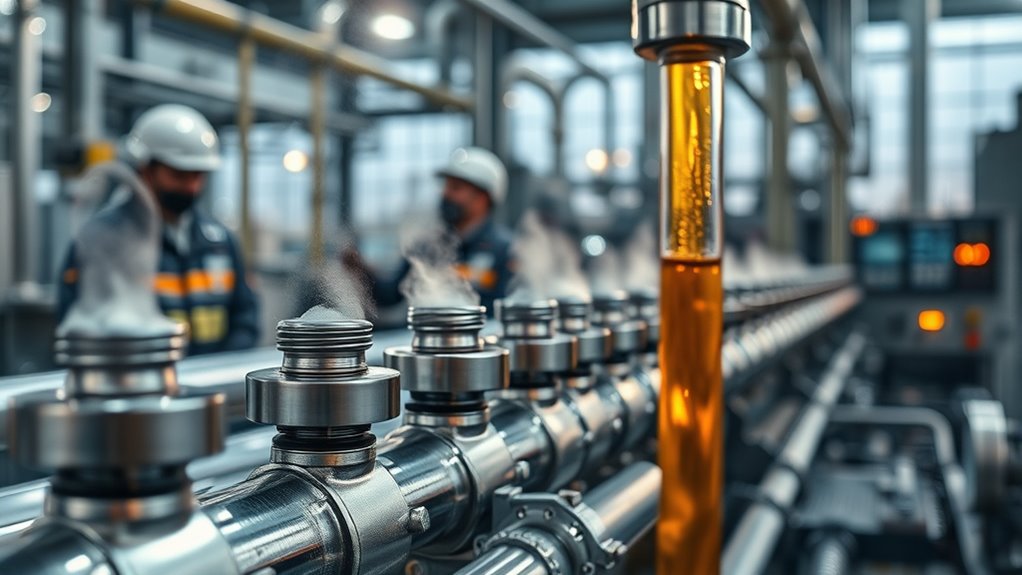
You start by heating crude oil to vaporize components, then separate jet fuel fractions through distillation based on boiling points.
Next, you hydroprocess it with hydrogen to remove impurities, improve stability, and boost quality.
After that, you blend in additives to enhance performance and test for safety standards.
The finished fuel is stored and delivered carefully to airports.
If you want to understand how renewables and environmental efforts shape jet fuel’s future, keep exploring.
Key Takeaways
- Crude oil is heated to 350°C–400°C to vaporize hydrocarbons for distillation.
- Distillation separates jet fuel fractions boiling between 200°C and 300°C.
- Hydroprocessing removes sulfur, nitrogen, and metals, improving fuel stability and cleanliness.
- Blending adjusts aromatic content and adds additives for performance and safety compliance.
- Final fuel is stored, tested, and transported to aircraft using specialized systems.
What Is Jet Fuel and Why It’s Special
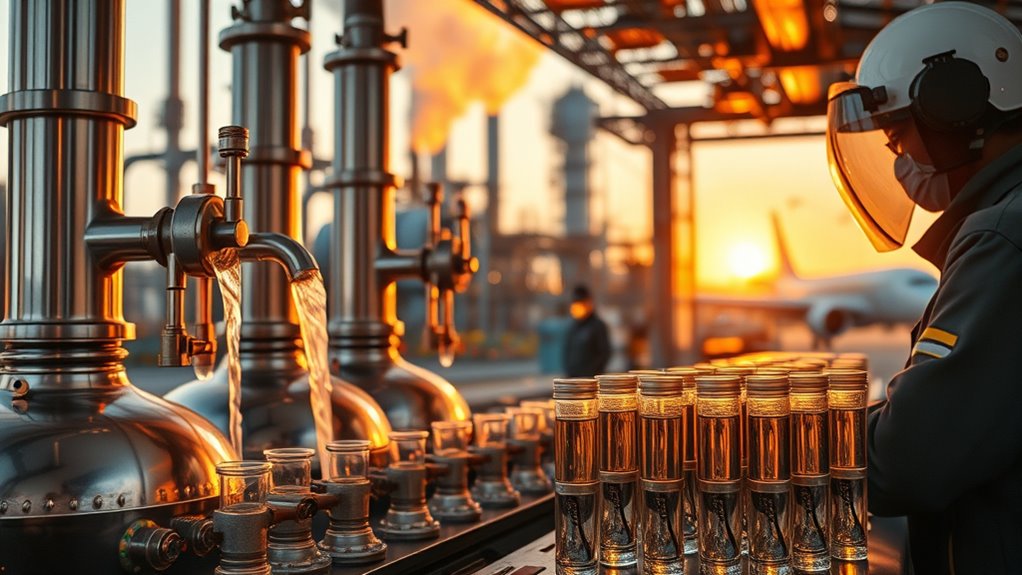
What makes jet fuel different from other fuels you might know? Jet fuel is specially formulated for aircraft engines, offering a high energy density that powers planes efficiently at high altitudes. Unlike gasoline or diesel, jet fuel contains a blend of hydrocarbons, mainly aliphatic compounds, with a small amount of aromatic hydrocarbons added to maintain fuel stability.
This unique composition guarantees jet fuel burns cleaner and more steadily, reducing engine wear and harmful emissions. One vital feature you should know about is its low freezing point. Because planes fly in extremely cold conditions, jet fuel must resist solidifying to keep engines running smoothly and safely.
These carefully balanced properties guarantee that jet fuel performs reliably under stress, providing smooth and efficient operation during every flight. When you consider these factors, it’s clear why jet fuel stands out as a specialized fuel designed for the demanding environment of aviation.
Where Jet Fuel Comes From
You might not realize it, but most jet fuel actually starts as crude oil. This oil is pulled from deep underground reservoirs, and it’s packed with all sorts of hydrocarbons. From there, the raw material goes through refining, which separates jet fuel from other products like gasoline and diesel.
Lately, you’re also seeing some new alternatives popping up. These are made from things like biomass and captured CO2, and they’re starting to step into the mix alongside traditional jet fuel.
Crude Oil Origins
Ever wonder where jet fuel actually comes from? It starts deep underground with crude oil, a complex mix of hydrocarbons extracted through drilling. This crude oil serves as the raw material in the refining process that transforms it into jet fuel.
The exact makeup of crude oil varies by location, influencing how it’s refined and the quality of the jet fuel produced. Sometimes, natural gas liquids are added to improve jet fuel yield. While synthetic sources like biomass are emerging, crude oil remains the primary source today.
| Origin Region | Hydrocarbon Type | Impact on Refining |
|---|---|---|
| Middle East | Mostly Alkanes | Easier refining |
| North America | Mix of Aromatics | Requires advanced refining |
| Russia | Cycloalkanes | Moderate refining |
| West Africa | Variable | Refining varies |
Hydrocarbon Composition Sources
Jet fuel comes from a mixture of hydrocarbons separated during refining, each with different boiling points. These hydrocarbons include aliphatic and aromatic compounds, essential for the fuel’s performance and stability.
During refining, crude oil breaks down into fractions, allowing you to isolate the components ideal for jet fuel. Here’s what you need to know about hydrocarbon composition sources:
- Crude oil provides a complex mix of hydrocarbons as the primary source.
- Aromatic hydrocarbons enhance fuel stability and protect aircraft parts.
- Refining processes separate these hydrocarbons by boiling point to create the right blend.
- Renewable sources like biomass and CO2 are being explored for producing synthetic hydrocarbons.
Understanding these sources helps you grasp how jet fuel meets strict aviation standards.
Emerging Fuel Alternatives
How are we moving beyond traditional sources to fuel the skies? You can now tap into emerging fuel alternatives like synthetic fuels made from CO2 and renewable energy, which slash lifecycle emissions by up to 90%.
Power-to-Liquid (PtL) eSAF transforms CO2, water, and electricity into hydrocarbons using electrochemical and Fischer–Tropsch methods. This offers a cleaner aviation fuel.
Biomass conversion also plays a key role. Lignin, vegetable oils, and algae oils undergo advanced catalytic processes to become sustainable jet fuels.
Moreover, synthetic fuels derived from natural gas, coal, or biomass use gasification and catalytic techniques to produce clean, sulfur-free jet fuel.
Innovations in converting waste lignin into aromatic hydrocarbons enable fully renewable, high-performance fuels. This marks a significant shift in how jet fuel is sourced and made.
Preparing Crude Oil for Jet Fuel
You start by heating crude oil in large furnaces to vaporize its components. Then, the vapor rises through a distillation column where it separates into fractions based on boiling points. The lighter fractions, including those for jet fuel, are collected for further refining.
Crude Oil Heating
Before crude oil can be separated into jet fuel and other products, refineries heat it in large furnaces until it vaporizes. This essential heating step prepares the crude oil for the distillation process by raising its temperature to around 350°C to 400°C. Proper heating guarantees the crude oil vaporizes efficiently without cracking or causing unwanted reactions.
Here’s what happens during crude oil heating:
- Crude oil enters large furnaces designed to evenly heat the mixture.
- The temperature rises, causing different hydrocarbons to vaporize at specific boiling points.
- This vaporized crude oil is now ready for the distillation column.
- Controlled heating maximizes separation during distillation, maximizing jet fuel yield.
You’ll see how vital effective heating is before distillation begins.
Distillation Column Process
Where do the different components of crude oil go once it’s heated? After heating in a furnace, the crude oil enters the distillation column, where the real separation happens. Inside this tall column, hydrocarbons separate based on their boiling points.
Lighter hydrocarbons with lower boiling points rise to the top, while heavier ones settle near the bottom. The jet fuel fraction, which boils between roughly 200°C and 300°C, is carefully isolated from other hydrocarbons during this process.
Heavier residues and gases unsuitable for jet fuel are removed at various points in the column. This distillation process prepares the jet fuel fraction for the next refining steps, ensuring you get a cleaner, more efficient fuel ready for aviation use.
Fraction Separation Steps
How exactly do refineries separate the complex mix of hydrocarbons in crude oil to isolate the jet fuel fraction? The process starts by heating crude oil in large furnaces, vaporizing its hydrocarbons. This vapor then enters a distillation column, where separation happens based on boiling points. Here’s how it works:
- Crude oil is heated to vaporize its components.
- Vaporized hydrocarbons rise through the distillation column.
- Fractions separate by boiling points. Lighter ones rise higher, heavier settle lower.
- The jet fuel fraction, boiling between 150°C and 300°C, is collected for further refining.
This distillation step transforms crude oil into manageable layers, letting you isolate the jet fuel fraction effectively for targeted processing.
What Distillation Does in Jet Fuel Production
Although crude oil contains many compounds, distillation separates them based on their boiling points, allowing you to isolate the fraction suitable for jet fuel. During distillation, hydrocarbons with specific boiling point ranges are separated from heavier residues and lighter gases, which aren’t ideal for aircraft engines.
This process transforms raw crude oil into distinct fractions, making it easier for you to collect and refine the jet fuel portion. The fraction isolated contains hydrocarbons that match jet fuel’s requirements and can then undergo further processing or blending to meet quality standards.
| Fraction Type | Boiling Point Range (°C) |
|---|---|
| Light gases | < 30 |
| Jet fuel hydrocarbons | 150 – 300 |
| Heavy residues | > 350 |
Distillation is essential because it efficiently separates hydrocarbons, giving you a manageable feedstock for producing reliable jet fuel.
How Hydroprocessing Makes Jet Fuel Cleaner
You’ll see, hydroprocessing uses hydrogen under high pressure and temperature to remove impurities like sulfur and nitrogen from jet fuel. This treatment doesn’t just clean the fuel; it also stabilizes it by saturating unsaturated hydrocarbons. Because of that, the fuel burns cleaner and performs more reliably in engines.
Hydrogen Treatment Process
Why does jet fuel need hydrogen treatment? Hydroprocessing uses hydrogen gas at high pressure and temperature, combined with a catalyst, to improve jet fuel quality through impurities removal. This step is essential because it transforms harmful sulfur and nitrogen compounds into gases like hydrogen sulfide and ammonia, which are then extracted from the fuel.
Here’s what hydrogen treatment does for jet fuel:
- Removes sulfur, nitrogen, and metal impurities.
- Saturates unsaturated hydrocarbons, boosting stability.
- Enhances thermal stability, reducing engine wear.
- Produces cleaner, environmentally friendly fuel that meets aviation standards.
Impurity Removal Techniques
When hydroprocessing jet fuel, hydrogen reacts with impurities like sulfur, nitrogen, and metals to convert them into removable compounds, making the fuel cleaner and safer for engines. This impurity removal technique uses hydrogen under high pressure and temperature with a catalyst to break down sulfur compounds into hydrogen sulfide, which is then separated from the fuel.
Hydroprocessing markedly lowers the sulfur content, often achieving levels below 0.3 wt%, meeting strict aviation standards. Besides sulfur, nitrogen and metal impurities are also removed, resulting in purer jet fuel.
Fuel Stability Enhancement
How exactly does hydroprocessing enhance the stability of jet fuel? Hydroprocessing uses hydrogen, high pressure, and catalysts to remove impurities like sulfur, nitrogen, and metals from jet fuel. This process saturates unsaturated hydrocarbons, which directly improves fuel stability by reducing gums and deposits.
Here’s how hydroprocessing boosts fuel stability:
- Removes impurities that cause corrosion and engine wear
- Saturates hydrocarbons, preventing oxidation and gum formation
- Enhances thermal stability for reliable high-altitude performance
- Improves freezing point and viscosity, ensuring smooth operation
How Hydrocracking Increases Jet Fuel Yield
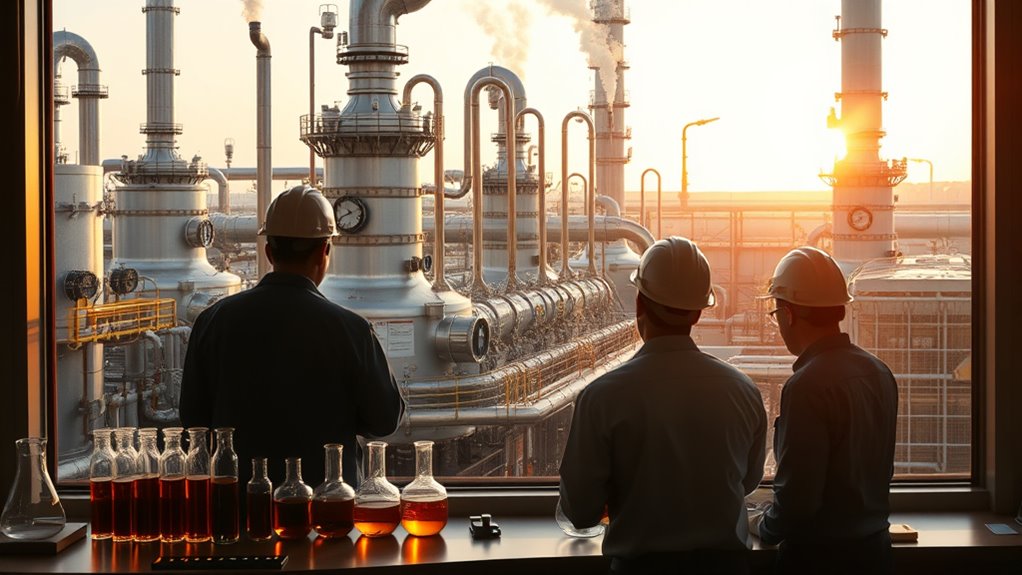
What makes hydrocracking a key process in jet fuel production is its ability to break down larger, less useful hydrocarbons into smaller, high-value molecules that fit the kerosene range ideal for aviation. In the refining process, hydrocracking uses hydrogen and a catalyst to convert heavy fractions into jet fuel-range hydrocarbons, considerably increasing jet fuel yield.
By adjusting operational conditions, you can optimize the process to produce more kerosene-sized molecules from crude or heavier feedstocks that would otherwise be wasted or downgraded. Hydrocracking also removes impurities like sulfur, nitrogen, and oxygen, which improves fuel quality and helps meet strict aviation standards.
This makes the refining process more efficient, ensuring that more raw hydrocarbon materials become usable jet fuel. Ultimately, hydrocracking plays a vital role by maximizing both the quantity and quality of jet fuel produced, helping refineries meet growing aviation fuel demands without compromising environmental and performance requirements.
How Blending Creates the Final Jet Fuel Formula
Although refining processes produce various hydrocarbon streams, blending combines these different components to create the final jet fuel formula that meets strict aviation standards. During blending, you mix straight-run kerosene, hydrocracked products, and bio-derived fractions to achieve the right balance of fuel properties.
Controlling the aromatic content is vital; typical blends contain 75-90% aliphatic hydrocarbons and 10-25% aromatics to guarantee performance and compatibility.
Here’s what you focus on in blending:
- Adjusting ratios to meet regulatory limits, including a maximum 25% aromatic content and minimum flashpoint of 38°C.
- Assuring the final fuel meets freezing point, viscosity, and energy content specifications.
- Combining hydrocarbon streams to optimize fuel stability and combustion quality.
- Testing the blend thoroughly before distribution to guarantee safety and efficiency.
Blending is fundamental to tailor jet fuel’s chemical makeup, resulting in a reliable and standardized product for aviation use.
Additives That Improve Jet Fuel Performance
Since jet fuel must perform reliably under extreme conditions, additives play a crucial role in enhancing its stability and safety. You’ll find antioxidants added to prevent gum formation, which can clog fuel lines and damage engines during storage.
Anti-icing additives, like organic acids or alcohols, reduce ice buildup in fuel lines at high altitudes, ensuring smooth engine operation. You’ll also see fuel system icing inhibitors such as Tertiary Butyl Alcohol (TBA) that lower the freezing point of water in the fuel, further preventing ice-related issues.
Beyond that, detergents and dispersants keep engine components clean by preventing deposit buildup on fuel injectors. Lubricity additives improve the lubrication of fuel pumps and injectors, especially important in ultra-low sulfur jet fuels that tend to reduce natural lubrication.
These carefully chosen additives work together to maintain jet fuel’s performance, safety, and dependability throughout its journey from storage to combustion.
How Jet Fuel Is Tested for Safety and Efficiency
Additives help jet fuel perform reliably, but testing confirms it meets strict safety and efficiency standards before use. You’ll find that safety testing covers several vital properties to guarantee the fuel’s readiness for flight.
Additives enhance jet fuel reliability, while rigorous testing ensures it meets essential safety and efficiency standards before flight.
Here’s how jet fuel is tested:
- Flash point: You’ll check that it’s at least 38°C to prevent fire hazards during handling and use.
- Freezing point: Testing confirms the fuel remains fluid at extreme altitudes, typically below -47°C.
- Combustion efficiency: You assess calorific value and sooting index to guarantee maximum energy release and minimal soot buildup.
- Sulfur content: You verify it stays under 0.3 wt% for environmental compliance and engine safety.
Lab simulations and engine bench tests validate material compatibility and fuel performance under real operating conditions. These steps guarantee the fuel’s safety and efficiency before it ever reaches the aircraft.
How Jet Fuel Is Stored and Delivered to Airports
When jet fuel arrives at airports, it’s stored in large, insulated tanks designed to maintain quality and prevent contamination. This storage setup often includes multiple tanks to handle different grades or batches, helping you manage supply efficiently.
After refining, the fuel travels to airports through pipelines, tanker trucks, or ships, ensuring a steady flow. Before fueling aircraft, the jet fuel undergoes filtration to remove impurities and may be blended with additives to meet safety standards.
When it’s time to fuel planes, specialized fueling trucks or hydrant systems transfer the fuel safely and precisely from storage tanks to aircraft. This system guarantees that the fuel you use meets strict quality controls from refining to delivery, keeping every step secure and efficient.
Understanding this process helps you appreciate the complex logistics behind ensuring your plane’s fuel is ready for takeoff.
Environmental Practices for Greener Jet Fuel Production
Beyond storage and delivery, the aviation industry is focusing on cutting the environmental impact of jet fuel production. You can see this shift through the adoption of greener methods that prioritize sustainability and emissions reduction.
The aviation industry is embracing greener methods to reduce emissions and promote sustainable jet fuel production.
Sustainable aviation fuel (SAF) plays a key role here, especially Power-to-Liquid eSAF, which uses renewable electricity and captures CO2 to lower lifecycle emissions by up to 90%. Catalysts also enhance these processes by boosting the conversion of biomass components like lignin into valuable jet fuel components.
Here are four environmental practices shaping greener jet fuel production:
- Using renewable electricity to power electrochemical CO2 conversion, creating a closed carbon loop.
- Applying advanced catalysts to convert biomass into aromatic hydrocarbons efficiently.
- Processing lignin waste sustainably, turning byproducts into jet fuel ingredients.
- Conducting large-scale testing to certify bio-derived fuels meet strict environmental standards.
These efforts help you support a cleaner, more sustainable aviation future.
Can Jet Fuel Be Made From Renewable Sources?
Although traditional jet fuel relies heavily on fossil resources, you can now find jet fuel made from renewable sources like biomass, algae oils, and waste fats. Through biofuel production methods such as hydroprocessing and Fischer-Tropsch synthesis, these materials transform into sustainable aviation fuel (SAF) that drastically cuts carbon emissions by up to 90% over the fuel’s lifecycle compared to conventional jet fuel.
Advances like Power-to-Liquid (PtL) technology even use renewable electricity and captured CO2 to create synthetic jet fuels, reducing fossil dependence further. Researchers are working on fully renewable jet fuel components, including aromatics and aliphatic hydrocarbons, to replace fossil-derived fuels entirely.
Certification processes ensure these bio-derived fuels meet strict safety and performance standards for safe aviation use. So, yes, you can rely on renewable jet fuel that supports greener skies while maintaining the performance and safety you expect from traditional fuels.
Frequently Asked Questions
How Is Jet Fuel Priced in the Global Market?
You’ll see jet fuel priced in the global market based on several factors. Market volatility plays a big role, as crude oil prices fluctuate daily. Pricing strategies depend on benchmark indices like Singapore Jet Kero and NY Harbor futures.
Geopolitical influence can cause sudden price spikes or drops, especially during conflicts or sanctions. Seasonal demand and refining capacity also impact prices, so you need to stay aware of these variables to understand jet fuel costs.
What Equipment Is Used to Transport Jet Fuel Within Refineries?
You might think jet fuel just magically moves around refineries, but nope. You rely heavily on storage tanks and pipeline infrastructure to keep it flowing.
These aren’t just pipes and containers; they’re equipped with safety valves to prevent accidents and spills. Without these, transporting jet fuel would be a risky guessing game.
How Do Refineries Handle Jet Fuel Spills or Leaks Safely?
When you handle jet fuel spills or leaks, you focus on fuel spill prevention and activate emergency response procedures immediately. You contain the spill quickly using booms and barriers, then deploy cleanup crews with chemical dispersants to reduce environmental impact.
You shut down affected equipment and ventilate the area to prevent hazards. Finally, you notify environmental agencies and test residual fuel levels to guarantee safety before resuming operations.
What Are the Main Challenges in Jet Fuel Supply Chain Logistics?
You’ll face major challenges in jet fuel supply chain logistics like maintaining supply chain transparency to guarantee fuel quality and compliance. Cold chain management is essential to prevent fuel degradation during storage and transport.
Plus, inventory tracking must be precise to handle fluctuating demand and avoid shortages or excess. Coordinating these factors while managing safety and environmental risks makes the logistics process complex and demanding.
How Is Jet Fuel Quality Monitored During Airline Fueling Operations?
You keep a vigilant eye on jet fuel quality during fueling, like a guardian scanning for hidden threats. Through continuous monitoring procedures and quality testing, you catch fuel contamination before it sneaks in.
On-site sensors measure sulfur content, density, and more, while samples undergo lab analysis for microbes and particulates. These steps guarantee every drop meets strict standards, protecting engines and keeping flights safe and smooth from takeoff to touchdown.
Conclusion
Now that you’ve taken this flight through jet fuel’s journey, you see it’s more than just liquid energy. It’s the lifeblood of the skies. From crude oil’s rough beginnings to the refined, clean fuel powering jets, each step is a careful dance of science and precision.
As we steer toward greener horizons, remember: every drop counts, fueling not just planes but the future of flight itself. Ready to soar smarter and cleaner?