
What Happens When Spark Plugs Cause the Check Engine Light?
When your spark plugs cause the check engine light, it means your engine is misfiring and running inefficiently. You’ll likely notice rough idling, harder starts, and reduced fuel economy.
Misfires increase emissions and can damage your catalytic converter if left unchecked. The engine control module detects these irregularities and triggers the light to warn you.
Understanding how spark plugs affect your engine and what signs to watch for can help you avoid costly repairs and keep everything running smoothly.
Key Takeaways
- Faulty spark plugs cause engine misfires, triggering the check engine light through detected irregular ignition signals.
- The engine control module records misfire trouble codes like P0300, indicating ignition problems from spark plugs.
- Misfires lead to incomplete combustion, increasing fuel consumption, emissions, and rough engine performance.
- Persistent spark plug issues risk catalytic converter damage if the check engine light is ignored.
- Diagnosing spark plug faults requires physical inspection or specialized tools beyond just reading engine codes.
Common Engine Symptoms of Bad Spark Plugs

When your spark plugs start to fail, you’ll notice your engine misfiring, which causes rough idling and hesitation during acceleration. These engine misfires happen because faulty spark plugs can’t ignite the fuel-air mixture efficiently.
Engine misfires, rough idling, and hesitation often signal failing spark plugs struggling to ignite the fuel-air mixture.
You might also find it harder to start your vehicle, with longer cranking times signaling that your spark plugs are wearing out. As combustion becomes less efficient, your fuel consumption increases, and your fuel efficiency drops, costing you more at the pump.
You may even feel excessive vibrations or hear knocking and rattling noises while idling, which are typical signs of deteriorated spark plugs. While these symptoms don’t always trigger your check engine light immediately, they often precede it.
Recognizing these common engine symptoms early can help you avoid more serious issues and maintain smooth engine performance. Keeping an eye on how your spark plugs affect your engine will save you time and money in the long run.
How Faulty Spark Plugs Cause the Check Engine Light
If your spark plugs fail to ignite the fuel-air mixture properly, your engine control module (ECM) will detect misfires and trigger the check engine light to warn you. Faulty spark plugs wear out or become fouled, causing incomplete combustion and misfire events.
The ECM constantly monitors engine performance and registers these misfires as diagnostic trouble codes (DTCs). When misfires happen repeatedly due to bad spark plugs, the check engine light turns on to alert you of a problem.
While the ECM may not always identify spark plugs specifically, misfire-related codes suggest that faulty spark plugs could be the root cause. Even if the ECM can’t pinpoint spark plug issues directly, the presence of misfire codes and the illuminated check engine light serve as clear indicators that your ignition system needs attention.
Addressing faulty spark plugs promptly helps prevent further engine damage and ensures smoother performance.
Why Spark Plug Misfires Turn On Your Check Engine Light
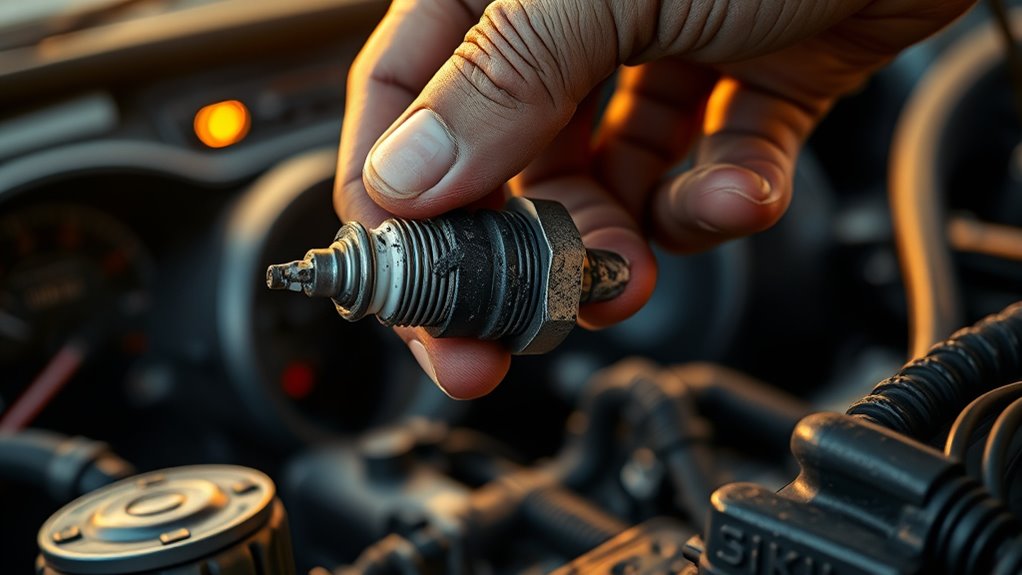
Because spark plug misfires disrupt proper combustion, your engine control module (ECM) quickly detects irregular ignition signals and triggers the check engine light to warn you of a problem. When a spark plug misfires, the ECM identifies unburned fuel in the combustion chamber and records fault codes like P0300 or P0301, pinpointing the misfire’s source.
This immediate detection helps prevent further engine damage by alerting you early. If the misfire continues due to worn or faulty spark plugs, the check engine light may flash or stay on steadily, signaling a persistent issue.
The check engine light isn’t just a random warning. It’s your ECM’s way of saying that your spark plugs need attention before the misfire causes more serious complications. By understanding this, you can act swiftly when the light turns on and avoid costly repairs down the road.
Visual Signs Your Spark Plugs Need Replacing
You can often tell when your spark plugs need replacing by checking for carbon buildup or black soot on the tips. It’s a clear sign that something’s off.
Also, take a close look at the electrodes. If they’re worn down, rounded, or chipped, that means they’re past their prime.
Don’t forget to inspect the ceramic insulator too. Cracks or damage there can really mess with performance. So, keeping an eye on these signs can save you from bigger engine problems down the road.
Carbon Buildup Indicators
When you notice black, sooty deposits coating your spark plug tips, it’s a clear sign of excessive carbon buildup caused by inefficient combustion. This carbon deposits layer points to fouled spark plugs, which can lead to engine misfire and decreased performance.
Here’s what to look for:
- A thick, dark coating on the electrodes that dulls the spark plug’s ability to ignite the fuel-air mix.
- A spark plug that looks heavily sooted or blackened, often from running a rich fuel mixture or oil contamination.
- Signs of erosion or wear beneath the carbon layer, indicating reduced effectiveness and potential need for replacement.
Spotting these carbon buildup indicators early helps you avoid misfires and maintain engine health.
Electrode Wear Signs
Although spark plugs may look fine at a glance, worn electrodes can quietly undermine your engine’s performance. Electrode wear often shows up as erosion, where the electrode tip becomes rounded, uneven, or thinner than it should be.
You might spot visual signs like carbon deposits or a dull, blackened surface on the electrode. Excessive gaps caused by electrode wear lead to weak or inconsistent sparks, which can trigger your check engine light.
In more severe cases, melting or pitting on the electrodes indicates overheating and significant wear. If you notice these visual signs on your spark plugs, it’s a clear indicator they’re nearing the end of their service life and should be replaced to maintain engine efficiency.
Insulator Damage Detection
Electrode wear isn’t the only spark plug issue that can cause trouble; damage to the ceramic insulator also signals a problem. You should inspect the spark plugs closely for insulator damage, as it often leads to engine misfires.
Here are three visual signs to watch for:
- Cracks or fractures in the ceramic insulator, often caused by excessive heat or improper installation.
- Oily deposits or carbon buildup around the insulator, indicating fouling and potential damage.
- Discoloration or burn marks on the insulator, which suggest overheating or electrical faults.
If you spot any of these signs, replace the spark plugs promptly to avoid misfires and further engine issues. Recognizing insulator damage early helps keep your engine running smoothly and prevents the check engine light from coming on.
How Bad Spark Plugs Affect Fuel Efficiency and Emissions
When your spark plugs start to go bad, your engine has to work a bit harder than usual. And that means you’ll end up using more fuel than you really need to. It’s not just about burning more gas, though. When your engine struggles like this, it also pumps out more harmful emissions.
Reduced Fuel Economy
How does a faulty spark plug impact your car’s fuel efficiency? When spark plugs wear out or misfire, they cause incomplete combustion. This forces your engine to work harder and burn more fuel. This directly lowers your fuel economy. Here’s how faulty spark plugs affect fuel efficiency:
- Incomplete combustion means your engine doesn’t use fuel properly, wasting gas.
- Misfires disrupt the air-fuel ratio, leading to inefficient burning and increased fuel consumption.
- The engine compensates for weak sparks by consuming more fuel to maintain power.
If your check engine light comes on, it might be signaling spark plug issues that reduce fuel economy. Replacing spark plugs regularly helps keep combustion optimal. This improves mileage and saves you money at the pump.
Increased Emission Output
Although you may not notice it immediately, faulty spark plugs can considerably increase your vehicle’s emissions by causing incomplete combustion. When spark plugs don’t ignite the air-fuel mixture properly, unburned hydrocarbons and carbon monoxide escape into the atmosphere, raising emissions levels.
This incomplete combustion forces your engine to burn more fuel, reducing overall efficiency and increasing emissions per mile. Plus, your catalytic converter has to work harder to clean up these pollutants, which can lead to damage over time.
How Bad Spark Plugs Make Your Car Hard to Start

Because spark plugs play a crucial role in igniting your engine’s fuel mixture, worn or fouled plugs can make starting your car a real struggle. When spark plugs don’t work properly, you’ll notice your vehicle is hard to start and might experience misfires during ignition. Here’s why faulty spark plugs impact startup:
- Worn electrodes or deposits on spark plugs weaken the spark, causing extended cranking times.
- Damaged insulators disrupt the ignition process, making the engine sputter or stall before starting.
- Poorly gapped or overheated spark plugs reduce spark strength, preventing quick and efficient combustion.
These issues mean your engine struggles to ignite the fuel mixture, resulting in a longer, rougher startup. If you’re facing hard-to-start symptoms, checking your spark plugs should be a priority to avoid misfires and guarantee smooth engine ignition.
What Happens Inside the Engine During a Spark Plug Misfire
When a spark plug misfires, it basically interrupts the combustion process inside your engine. This can lead to rough performance and you’ll definitely notice a drop in power. On top of that, you’ll see increased emissions and your fuel consumption will go up because the air-fuel mixture isn’t burning completely.
These problems don’t just hurt your engine’s efficiency—they can also cause the check engine light to come on, giving you a warning that something needs attention.
Combustion Process Disruption
If your spark plug misfires, the ignition of the air-fuel mixture inside the cylinder gets delayed or doesn’t happen at all, throwing off the entire combustion process. This disruption impacts your engine in several ways:
- The incomplete combustion allows unburned fuel to flow into the exhaust system, increasing harmful emissions.
- Pressure inside the cylinders becomes uneven, causing rough idling and noticeable vibrations.
- The engine control module detects these irregular firing patterns and triggers the check engine light as a warning.
Your spark plugs play a crucial role in maintaining smooth combustion. When they fail, this engine misfire interrupts the combustion process, leading to inefficiencies and potential internal damage if left unaddressed. Recognizing this disruption early helps prevent further engine issues.
Effects On Engine Performance
Although spark plugs are small components, their failure can greatly disrupt your engine’s performance. When a spark plug misfires, it fails to ignite the air-fuel mixture properly, causing incomplete combustion. This misfire creates inconsistent power strokes, leading to rough idling and noticeable engine vibrations. Your engine control module detects this abnormal behavior, triggering the check engine light.
| Misfire Effect | Impact on Engine |
|---|---|
| Incomplete Combustion | Reduced power output |
| Rough Idling | Engine vibrations |
| Irregular Sparks | Uneven engine performance |
| Increased Wear | Lower engine efficiency |
Each misfire reduces overall engine performance and stresses components, impairing your vehicle’s smooth operation until you replace faulty spark plugs.
Increased Emissions And Fuel Use
Because a spark plug misfire disrupts proper combustion, your engine ends up releasing unburned fuel into the exhaust system. This increases emissions and fuel consumption, as your engine struggles to run efficiently.
Here’s what happens inside your engine:
- Unburned fuel raises hydrocarbon levels in the exhaust, hiking emissions.
- Irregular ignition timing forces your engine to use more fuel to compensate.
- Oxygen sensors detect the abnormal exhaust, causing the check engine light to come on.
Over time, continuous misfires can damage the catalytic converter, worsening emissions and performance. Faulty spark plugs disrupt the combustion process, making your vehicle less eco-friendly and costing you more at the pump.
Addressing spark plug issues promptly helps reduce emissions and improves fuel economy.
Why the Engine Control Module Can’t Detect Spark Plug Faults Directly
While the Engine Control Module (ECM) can detect when your engine misfires, it can’t directly identify if the issue comes from worn or faulty spark plugs. The ECM relies on misfire detection sensors to spot irregular combustion and triggers diagnostic trouble codes related to misfires.
However, these codes don’t specify whether the spark plugs are at fault or if the problem lies elsewhere in the ignition or fuel system. Because the ECM doesn’t monitor spark plug condition directly, it can’t pinpoint spark plug faults with precision.
This limits its ability to give you a clear diagnosis solely based on sensor data. To accurately identify spark plug problems, you’ll need a physical inspection or specialized diagnostic tools beyond what the ECM provides.
In short, while the ECM alerts you to misfires, it can’t tell you if worn spark plugs are the cause without further investigation.
How Spark Plug Problems Can Damage the Catalytic Converter
How exactly can faulty spark plugs wreak havoc on your catalytic converter? When your spark plugs misfire, unburned fuel slips into the exhaust system, causing overheating and damaging the catalytic converter. This damage happens because the converter can’t properly process these excess emissions.
Here’s how spark plug problems hurt your catalytic converter:
- Misfires increase emissions, which can clog or even melt the catalytic converter’s internal components.
- Continuous misfiring forces the catalytic converter to work harder, speeding up its wear and tear.
- Poor combustion leaves unprocessed exhaust gases that chemically harm the catalytic converter, leading to failure.
Ignoring spark plug issues means your catalytic converter faces constant stress from high exhaust temperatures and harmful chemicals. This not only damages the catalytic converter but also leads to expensive repairs.
Keeping your spark plugs in good shape is crucial to protecting this vital part of your vehicle’s emission control system.
When to Replace Spark Plugs to Avoid Check Engine Light
Faulty spark plugs don’t just damage your catalytic converter, they can also trigger your check engine light. To avoid this, you should replace spark plugs every 80,000 miles or follow the schedule recommended by your vehicle manufacturer.
Waiting too long can lead to worn or fouled plugs causing engine misfires, rough idling, or difficulty starting. These are clear signs it’s time for replacement. These issues often set off misfire codes like P0300-P0304, illuminating your check engine light.
Regular inspection and timely replacement prevent spark plug deterioration, keeping your engine running smoothly and reducing the risk of ignition problems. By proactively replacing spark plugs, you maintain ideal engine performance and avoid unexpected trips to the mechanic when the check engine light appears.
Don’t wait for the warning light to come on. Staying ahead with maintenance saves you time, money, and stress.
How Technicians Diagnose Spark Plug-Related Check Engine Lights
Because spark plug issues often trigger the check engine light, technicians rely on a mix of diagnostic tools and inspections to pinpoint the problem. First, they use an OBD-II scan tool to retrieve diagnostic trouble codes that reveal misfires or ignition issues linked to spark plugs.
Next, they perform a visual inspection of the spark plugs, checking for wear, deposits, or damage that could cause engine trouble. Finally, advanced diagnostic equipment monitors engine performance, including misfire counts and ignition coil activity, to confirm the spark plugs’ condition.
Here’s how they diagnose spark plug-related check engine lights:
- Scan for diagnostic trouble codes to identify specific cylinder misfires.
- Conduct a visual inspection of spark plugs for physical signs of failure.
- Analyze engine performance data to verify ignition system function and detect hidden issues.
This thorough approach ensures technicians accurately identify if spark plugs are behind the check engine light.
Spark Plug Maintenance Tips for Smooth Engine Performance
Identifying spark plug issues is just the first step. Maintaining them properly helps keep your engine running smoothly and prevents check engine lights from coming on.
Regularly inspect your spark plugs for wear like electrode erosion or deposits. Replace them as recommended, usually around 80,000 miles.
Use the correct spark plug type and keep the gaps adjusted to the specs. This guarantees ideal engine performance and helps avoid misfires.
Routine maintenance, including cleaning or replacing spark plugs, reduces ignition problems that trigger warning lights. If you notice rough idling or starting issues, schedule a professional diagnostic promptly.
| Maintenance Tip | Purpose | Frequency |
|---|---|---|
| Inspect spark plugs | Detect wear and deposits | Every 30,000 miles |
| Replace spark plugs | Guarantee ideal ignition | Every 80,000 miles |
| Check spark plug gap | Maintain efficient ignition | During inspection |
| Use manufacturer specs | Prevent misfires and engine issues | Always |
| Professional diagnostics | Address ignition faults | As needed |
Frequently Asked Questions
Can Using the Wrong Spark Plug Type Trigger the Check Engine Light?
Yes, using the wrong spark plug type can trigger the check engine light. You’ll likely experience misfires that confuse the ignition coil and cause the engine control unit to detect irregular firing.
This can hurt your fuel efficiency and mess with emissions control, making your car run poorly. To avoid this, always stick to the manufacturer’s recommended spark plugs to keep your engine running smoothly and prevent that annoying check engine light.
How Do Spark Plug Gaps Affect Engine Performance and Warning Lights?
Imagine you’re on a road trip when your check engine light suddenly flickers because your spark plug gaps are off. Incorrect gaps mess with ignition timing, causing misfires that hurt fuel efficiency and increase emissions.
This imbalance triggers warning lights as your engine struggles to keep combustion smooth. By keeping your spark plug gaps precise, you ensure ideal ignition timing, better fuel efficiency, and improved emission control, preventing those unwelcome alerts.
Are Spark Plug Issues Covered Under Typical Vehicle Warranties?
Typical vehicle warranties don’t usually cover spark plug issues unless they’re caused by a manufacturing defect. Since spark plugs are part of the ignition system, their wear affects fuel efficiency and emission control. But regular wear and tear is your responsibility.
If a spark plug failure happens prematurely due to a faulty part, some extended warranties might cover it. Always check your warranty terms to know what’s included.
Can Spark Plug Fouling Cause Permanent Engine Damage?
Did you know that poor ignition timing from fouled spark plugs can reduce fuel efficiency by up to 30%? Yes, spark plug fouling can cause permanent engine damage if left untreated. It disrupts ignition timing, leading to incomplete combustion and harming emission control systems.
Over time, this can cause carbon buildup and overheating, damaging engine valves and pistons. So, don’t ignore fouling. You’ll protect your engine’s performance and longevity.
How Often Should Spark Plugs Be Inspected if No Warning Lights Appear?
You should inspect your spark plugs every 30,000 to 50,000 miles, even if no warning lights appear. Regular checks help maintain proper ignition timing, which keeps your engine running smoothly.
This also boosts fuel efficiency and supports emissions control, preventing harmful pollutants from increasing. By staying proactive with inspections, you avoid unexpected issues and guarantee your vehicle performs at its best over time.
Conclusion
Did you know that faulty spark plugs cause about 30% of check engine light alerts? When your spark plugs misfire, your engine’s performance drops, fuel efficiency tanks, and emissions rise.
By staying on top of spark plug maintenance and replacing them when needed, you can avoid costly repairs and keep your engine running smoothly. Don’t ignore that check engine light; it’s your car’s way of telling you it’s time for a spark plug check.