How Hot Can Jet Fuel Burn?
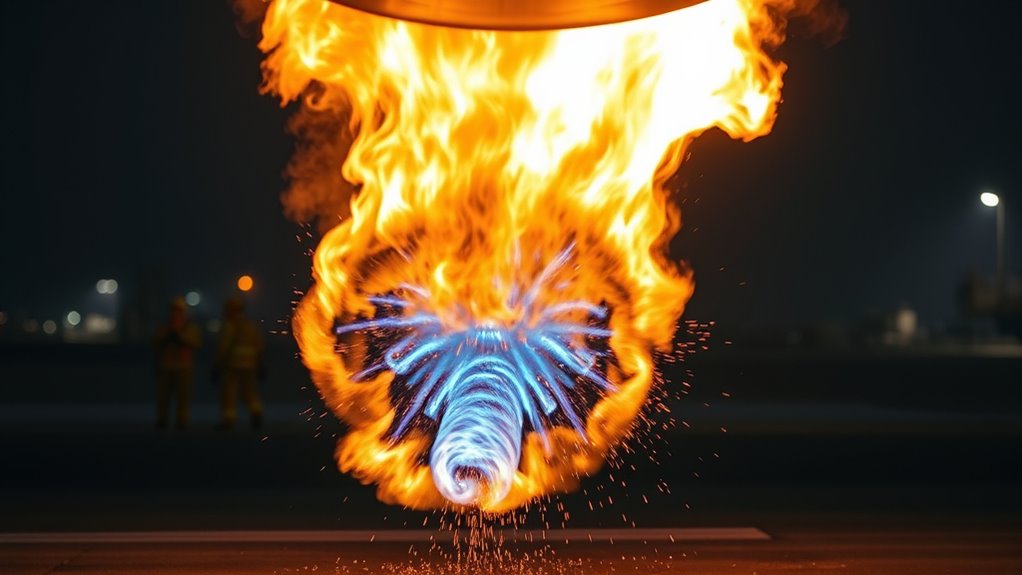
Jet fuel typically burns between 980°C and nearly 2,000°C, generating intense heat strong enough to weaken steel but not melt it. You’ll find ignition happens around 210°C, with flames reaching higher temperatures depending on oxygen levels and altitude.
Vapor-air mixtures also affect how it burns. Inside aircraft engines, advanced cooling protects essential parts from extreme heat. If you want to understand how environmental factors and engine design manage these temperatures, there’s plenty more to explore.
Key Takeaways
- Jet fuel flames can reach temperatures up to about 1,980°C (3,600°F) in open fires and engines.
- Inside turbine engines, combustion gases can reach nearly 2,000°C (3,632°F).
- Jet fuel ignites at approximately 210°C (410°F) and burns between 980°C and 1,500°C in open air.
- Despite high flame temperatures, jet fuel fires cannot melt steel, only weaken it above 550°C.
- Flame temperature varies with oxygen levels and altitude but generally remains near 1,980°C during combustion.
What Temperature Range Does Jet Fuel Typically Burn At?
Although jet fuel ignites at relatively low temperatures, around 210°C (410°F) for Jet A and 260°C (500°F) for Jet B, it typically burns at much higher temperatures. This range is about 980°C to 1,500°C (1,796°F to 2,732°F) in open air.
When you observe jet fuel combustion, you’ll notice the flame’s temperature is markedly higher than the initial ignition point. This combustion temperature range is vital for efficient engine performance, ensuring the fuel releases enough energy to power the turbine.
Inside a jet engine, the visible flame can reach nearly 1,980°C (3,600°F), while combustion gases exiting the turbine can soar to around 2,000°C (3,632°F). These high temperatures result from the rapid oxidation of fuel molecules, releasing heat and expanding gases that drive the engine.
Understanding this temperature range helps you appreciate how fuel combustion balances safety and efficiency in aviation technology, delivering the thrust necessary for flight.
How Oxygen Levels Affect Jet Fuel Combustion Temperatures
Because oxygen plays a crucial role in combustion, the amount present directly affects how hot jet fuel burns. When oxygen levels increase, the combustion temperature rises due to more complete oxidation of fuel hydrocarbons.
For example, jet fuel flames in pure oxygen can reach around 3,200°C (5,792°F), much hotter than the typical 2,000°C (3,632°F) flame temperature in air. On the other hand, if oxygen levels drop below atmospheric concentrations, the combustion temperature decreases, causing cooler flames and less efficient burning.
You’ll find the ideal combustion temperature occurs near atmospheric oxygen levels, about 21%, which balances maximum energy release with safe operation. Understanding how oxygen levels influence flame temperature lets you predict and control jet fuel combustion more effectively, whether for performance enhancement or safety.
Differences Between Jet A and Jet A-1 Burn Temperatures
Understanding how oxygen levels impact combustion temperatures sets the stage for comparing burn characteristics of different jet fuels. When it comes to Jet A and Jet A-1, their burn temperatures in the combustion chamber are remarkably similar. Both fuels ignite around 210°C (410°F) and can reach combustion chamber temperatures between roughly 980°C and 1,500°C (1,796°F to 2,732°F) during engine operation.
The key distinction lies not in burn temperatures but in freezing points, with Jet A-1 having a lower freezing point suited for colder climates.
You won’t notice significant differences in maximum flame temperatures, as both fuels produce gases that can reach about 2,000°C (3,632°F) during combustion. Whether you’re dealing with Jet A or Jet A-1, the combustion chamber environments and burn temperatures stay consistent, ensuring stable and efficient fuel performance under typical operating conditions.
How Altitude and Pressure Influence Jet Fuel Combustion Heat
When you fly at higher altitudes, the lower ambient temperatures can make jet fuel ignite more easily, but once it’s burning, the combustion temperature stays almost the same. Nevertheless, altitude and pressure still influence how hot jet fuel burns.
At lower altitudes, higher atmospheric pressure improves fuel vaporization, boosting combustion efficiency and raising flame temperatures. Conversely, as altitude increases, pressure drops, reducing oxygen availability and slightly limiting combustion efficiency.
This results in a modest decrease in the maximum combustion temperature of jet fuel, which typically ranges from 980 to 1,500°C. Furthermore, pressure differences across engine components affect how finely fuel atomizes and vaporizes, directly impacting the heat generated during combustion.
How Vapor-Air Mixtures Affect Jet Fuel Ignition and Burning
Altitude and pressure influence how jet fuel burns, but the actual ignition and sustained combustion depend heavily on the mixture of fuel vapor and air. You need a vapor-air mixture with a specific concentration for flammability, between 0.03% and 7.2% vapor by volume. If the mixture is too lean or too rich, it won’t ignite, reducing combustion risk.
Jet fuel vapor has a density about 5.7 times that of air, so it tends to settle in low areas. This affects how vapors accumulate in tanks or compartments.
For ignition to occur, the temperature must reach around 210°C (410°F), though this ignition temperature slightly varies with vapor concentration. Explosive conditions arise when the vapor-air ratio falls between 0.6% and 47%, meaning a broader range than just flammable limits can pose hazards.
Understanding these vapor-air mixture dynamics is essential for managing jet fuel ignition and controlling burning safely.
Jet Fuel Composition and Its Impact on Burning Characteristics
Because jet fuel is made up of various hydrocarbons like paraffins, cycloparaffins, aromatics, and olefins, its burning characteristics can vary considerably. These hydrocarbons influence the fuel’s energy content and volatility, directly affecting its combustion temperature.
For instance, Jet A and Jet A-1 fuels can reach flame temperatures of about 2,000°C in the combustion gases. The specific mix of hydrocarbons also determines how easily the fuel ignites, with autoignition temperatures typically around 210°C.
You’ll find that changes in hydrocarbon types or additive content can alter the fuel’s thermal stability, impacting how it behaves under high heat. Understanding this composition helps you predict jet fuel’s burning performance and manage combustion efficiently.
Jet Fuel Flash Point and Autoignition Safety Limits
Understanding jet fuel’s composition gives you insight into its burning behavior, but knowing its flash point and autoignition limits helps you handle it safely. Jet A and Jet A-1 have a flash point above 38°C (100°F), so they won’t ignite easily at lower temperatures. This higher flash point means you need a significant heat source to create flammable vapors.
The autoignition temperature sits around 210°C (410°F). This means jet fuel can spontaneously ignite if heated to this point without a spark or flame. You also need to be aware of flammability limits. The vapor-air mixture becomes flammable between about 0.6% and 47% vapor concentration.
Inside fuel tanks, even a narrower range of 0.03 to 0.072 poses explosion risks. So, handling jet fuel safely means keeping these factors in mind.
Why Jet Fuel Flames Don’t Melt Steel
You might think that jet fuel fires could melt steel, but actually, the flame temperature just isn’t high enough for that. Jet fuel burns at temperatures ranging from about 980°C to 1,500°C. On the other hand, steel melts at a temperature between roughly 1,425°C and 1,540°C. So, even when the flame is at its hottest, it doesn’t quite get to the point where steel would start to liquefy.
Flame Temperature Limits
Although jet fuel burns at extremely high temperatures, its flames never get hot enough to melt steel. The maximum flame temperature of jet fuel in open air reaches about 1,980°C (3,600°F), which sounds intense but remains below steel’s melting point.
Steel melts between 1,425°C and 1,540°C (2,597°F to 2,800°F), so the heat from jet fuel combustion just isn’t enough to liquefy it. Instead, the flames can raise steel’s temperature to around 550°C (1,022°F), weakening its structural strength without causing melting.
This flame temperature limit means that while jet fuel flames can severely damage steel by softening it, they can’t directly cause steel beams to melt. Understanding these heat boundaries clarifies why jet fuel fires behave the way they do in structural scenarios.
Steel Melting Point
Because steel melts at temperatures between 1,425°C and 1,540°C (2,597°F to 2,800°F), jet fuel flames simply can’t reach the heat needed to liquefy it. Jet fuel burn temperatures top out around 1,500°C (2,732°F), which is below steel’s melting point.
Although steel beams don’t melt in fires fueled by jet fuel, they do weaken significantly above 550°C (1,022°F), losing strength and deforming. This explains why steel structures can fail without the steel actually melting.
| Property | Temperature Range |
|---|---|
| Steel melting point | 1,425°C – 1,540°C |
| Jet fuel flame max | 980°C – 1,500°C |
| Steel weakening start | Above 550°C |
How Aircraft Engines Manage Jet Fuel Combustion Heat
You might be curious about how aircraft engines manage to burn jet fuel at scorching temperatures—up to 2,000°C—without getting damaged. Well, they carefully control the combustion temperatures to keep things in check.
On top of that, they use some pretty advanced cooling methods, like internal air passages and special thermal coatings. These clever techniques help prevent the engine parts from overheating, all while making sure the engine stays powerful and efficient.
Combustion Temperature Control
When jet fuel burns inside an aircraft engine, the temperatures can soar to nearly 1,980°C (3,600°F), pushing materials to their limits. To control combustion temperature, you’ll see fuel temperature carefully managed and the fuel-air mixture precisely adjusted to keep heat within safe bounds.
Thermal barrier coatings protect turbine blades from extreme heat, allowing them to endure these intense conditions without failing. Inside the engine, cooling passages circulate air to lower metal temperatures, while engineers regulate turbine inlet temperatures around 1,500°C (2,732°F) for ideal performance.
Heat Management Techniques
Although jet fuel combustion generates extreme heat nearing 2,000°C, aircraft engines use sophisticated heat management techniques to keep components safe and efficient. You’ll find thermal barrier coatings on turbine blades acting as insulators against intense heat.
Combustion chambers are designed to contain the flame and prevent damage. Plus, bleed air routed through internal cooling passages works as a heat sink, absorbing and dissipating heat to protect engine parts.
| Technique | Purpose |
|---|---|
| Thermal Barrier Coatings | Insulate turbine blades |
| Combustion Chambers | Contain and manage flame heat |
| Heat Sink (Bleed Air) | Absorb and dissipate excess heat |
What Happens to Jet Fuel Temperature During Fires and Crashes
Jet fuel can reach extreme temperatures during fires and crashes, often soaring from its normal flight range of 38°C to 54°C up to nearly 2,000°C or higher in combustion gases. When a fire breaks out, jet fuel burns fiercely, with combustion temperatures ranging between 980°C and 1,500°C in open air.
Jet fuel ignites fiercely, soaring from normal flight temperatures to nearly 2,000°C in intense fires.
In post-crash scenarios, these temperatures can spike even further, reaching about 2,000°C. You’ll see jet fuel create visible flames that sustain intense heat for extended periods, making fires particularly hazardous. This extreme heat markedly contributes to ongoing combustion and structural damage after a crash.
Understanding these temperature changes is vital because jet fuel behaves very differently in fire conditions compared to normal flight. So, when jet fuel ignites uncontrollably, it produces one of the hottest fires you’ll encounter, with flame temperatures around 1,980°C.
These intense combustion temperatures explain why fires involving jet fuel can be so destructive and challenging to control.
Engine Cooling and Temperature Control to Protect Aircraft
You rely on engine cooling systems to keep critical parts from overheating during flight. For example, circulating air through turbine blades is one way to manage the heat. Plus, thermal barrier coatings play a big role in regulating temperatures, keeping them well below dangerous limits.
It’s pretty interesting when you think about it—jet fuel burns at extremely high temperatures, yet these cooling techniques help protect the aircraft. Understanding how these mechanisms work really shows the clever engineering behind keeping everything running safely.
Cooling System Mechanisms
When engine temperatures soar beyond 2000°C, sophisticated cooling systems kick in to keep components safe and functional. You’ll find internal cooling passages circulating cooler air, around 700-800°C, which protects turbine blades from extreme heat.
Film cooling adds another layer of defense by ejecting a thin layer of high-pressure air through tiny holes on blade surfaces. This forms a protective barrier against scorching gases. On top of that, thermal barrier coatings, usually ceramic based, insulate engine parts, reducing heat transfer from combustion gases.
These cooling mechanisms work together to maintain turbine blade temperatures well below their melting points, around 1300°C for nickel alloys. This ensures the engine runs efficiently without material failure. Understanding these systems reveals how jet engines handle intense heat safely.
Temperature Regulation Techniques
Although turbine blades face extreme heat during operation, sophisticated temperature regulation techniques keep them within safe limits. You rely on these methods to guarantee engine durability and performance. Here’s how it works:
- Internal cooling passages and film cooling use bleed air to keep blade temperatures controlled.
- Thermal barrier coatings, usually ceramic-based, insulate components from intense combustion heat.
- Fuel vapor management through pre-heating and heat exchangers prevents freezing and aids temperature control at altitude.
- Temperature sensors continuously monitor engine conditions, feeding data to control systems that optimize cooling.
Debunking Common Myths About Jet Fuel Burn Temperatures
Since many people believe jet fuel can melt steel beams, it’s important to clarify that jet fuel burns at temperatures between about 980°C and 1,500°C (1,796°F to 2,732°F), which isn’t hot enough to melt steel. The melting point of structural steel ranges from 1,425°C to 1,540°C (2,597°F to 2,800°F), so jet fuel’s fire temperature falls short.
While the flash point of jet fuel, the lowest temperature at which it can vaporize to ignite, is around 38°C (100°F), this doesn’t affect the maximum burn temperature. Even in intense fires, temperatures rarely exceed 1,200°C (2,192°F), which is still not enough to melt steel beams.
Combustion gases can reach about 2,000°C (3,632°F), but the actual flame temperature in open air or building fires dissipates quickly. Understanding these facts helps debunk myths and clarifies that structural steel failure happens because it weakens at high heat, not because it melts.
Frequently Asked Questions
Can Jet Fuel Burns Cause Toxic Smoke or Harmful Emissions?
Yes, jet fuel burns can cause toxic smoke and harmful emissions that seriously affect air quality. When you encounter jet fuel fires, you’re exposed to toxic gases like carbon monoxide, nitrogen oxides, and sulfur oxides.
These gases raise emission levels, releasing dangerous substances that harm your respiratory system and the environment. You’ll want proper combustion control and filtration to reduce these risks and protect both your health and the air you breathe.
How Long Does Jet Fuel Continue Burning After Ignition?
You might imagine jet fuel flames flickering briefly, but once ignited, jet fuel can keep burning from seconds to several minutes, depending on fuel flammability and combustion temperature.
If fuel supply and oxygen are steady, the fire persists, fed by ignition sources. In big spills, flames can last hours, creating intense heat and danger.
What Safety Measures Exist for Handling Jet Fuel Spills?
You need to follow strict safety protocols when handling jet fuel spills to prevent fire containment failure. Always contain spills immediately and use appropriate fire extinguishers like foam or CO₂.
During spill cleanup, wear protective gear and use inert absorbent materials to soak up fuel safely. Proper ventilation is essential to disperse vapors, reducing ignition risk.
How Is Jet Fuel Storage Temperature Regulated to Prevent Hazards?
You regulate jet fuel storage temperature by using temperature monitoring systems that keep the fuel between its freezing and flash points. These systems include sensors that continuously check fuel temperature and active heating methods like fuel heaters or bleed air heat exchangers.
Are There Environmental Impacts From Jet Fuel Combustion Residues?
Yes, jet fuel combustion residues cause environmental pollution through particulate matter and toxic compounds. You’ll find residue toxicity from substances like polycyclic aromatic hydrocarbons and heavy metals, which pose health risks.
These residues affect ecosystems by contaminating soil and water, leading to harmful ecological effects on plants and aquatic life. To reduce impact, regulations push for cleaner combustion technologies and emissions controls that help protect the environment.
Conclusion
So, you’re worried jet fuel burns hot enough to melt steel? Well, sure, it does, but only if you’re roasting marshmallows in a jet engine’s combustion chamber.
Remember, jet fuel isn’t some mystical dragon’s breath; it’s science and precise engineering keeping planes flying safely. Next time you hear myths about jet fuel’s “superpower” flames, just smile and know: it’s hot, controlled, and definitely not your backyard bonfire material. Stay curious, not crispy!