How Do Air Shocks Work Step by Step
You start by pumping air into the shock’s sealed chamber, which compresses when your wheel hits a bump. This compressed air cushions the impact, absorbing energy and supporting your vehicle’s weight by adjusting pressure based on load.
Sensors detect terrain changes and send data to the control unit, which regulates valves and the compressor to inflate or deflate the shocks. This helps maintain ride height and comfort.
Keep going to understand how these parts work together and how to maintain them.
Key Takeaways
- Air shocks use compressed air inside a sealed chamber to absorb and cushion impacts from bumps and rough terrain.
- When a wheel hits a bump, the shock shaft compresses, increasing air pressure to evenly distribute impact forces.
- An air pump or compressor inflates the chamber via valves controlled by sensors and an electronic control unit (ECU).
- The ECU continuously adjusts air pressure to maintain ride height, stiffness, and vehicle stability based on load and terrain.
- Maintenance includes monitoring air pressure, inspecting seals and valves, and servicing compressors to ensure optimal shock performance.
What Are Air Shocks and How Do They Work
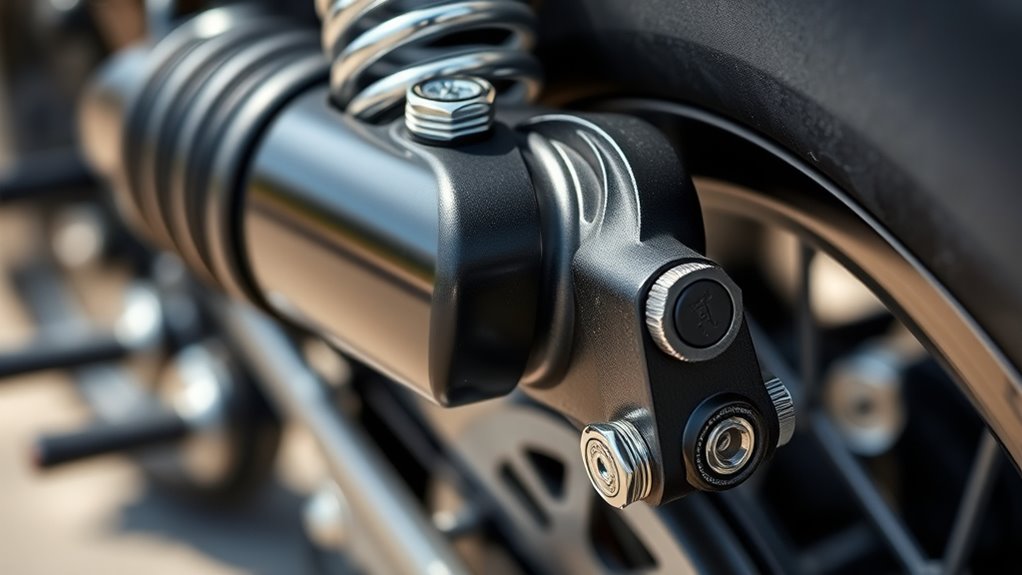
Although you might not see them working, air shocks play a crucial role in smoothing your ride by using pressurized air inside a sealed chamber to absorb impacts and support your vehicle’s weight. These air shocks are a key part of your suspension system, adjusting to changing road conditions and loads.
When you drive over bumps or rough terrain, the pressurized air inside the chamber compresses, cushioning the impact. The air compressor helps by inflating the chamber, increasing pressure to raise your vehicle ride height or firm up the suspension for better control. Conversely, releasing air softens the ride.
This ability to adjust air pressure means your suspension system adapts in real-time, maintaining comfort and stability. By controlling the air shocks accurately, your vehicle stays balanced, whether carrying heavy loads or cruising smoothly on highways, making your driving experience safer and more comfortable every time you get behind the wheel.
The Main Components Inside an Air Shock
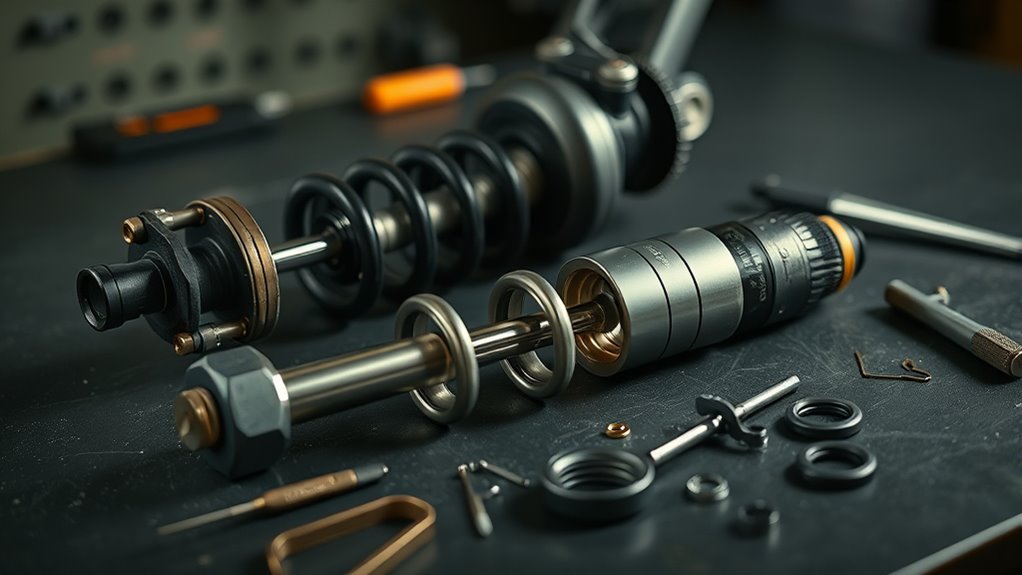
When you look inside an air shock, you’ll find several key components working together to control your ride’s comfort and stability. The air spring forms the main chamber filled with compressed air, providing adjustable support and cushioning. Attached to it is the damper, which manages how quickly your suspension compresses and rebounds, ensuring a smooth ride.
Inside, the piston and rod work hard to convert the kinetic energy from bumps into heat, which the shock dissipates to control movement. Seals and valves play a crucial role by maintaining air pressure and preventing leaks, letting you fine-tune the air spring’s firmness through inflation or deflation. You’ll also find internal baffles, which direct airflow inside the shock, helping regulate how the damper responds.
Together, these components balance comfort and control, making air shocks effective at adapting to different terrains and riding conditions.
How Compressed Air Absorbs Bumps and Impacts
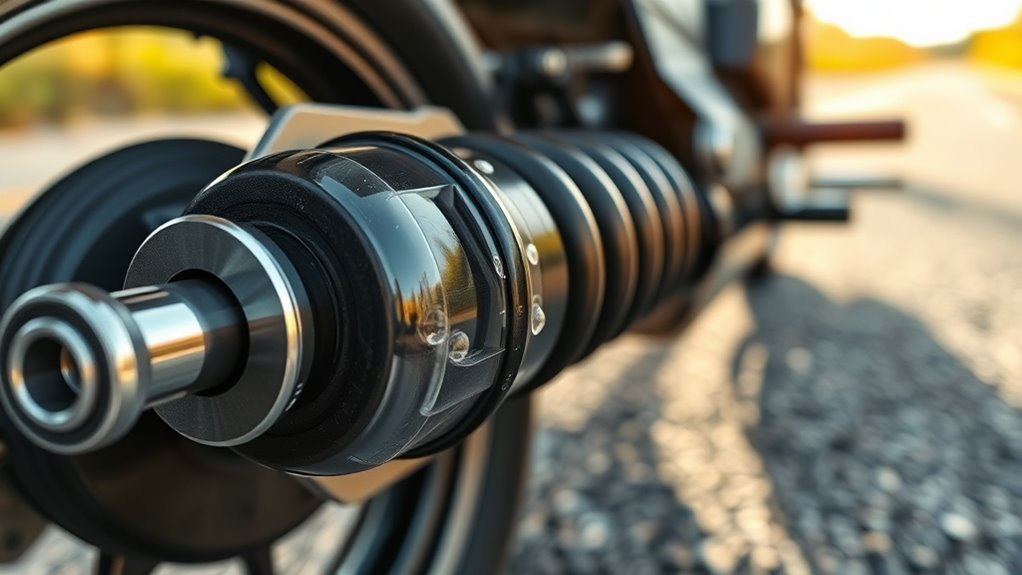
When your wheel hits a bump, it pushes the shock shaft, compressing the air inside the chamber. This compressed air cushions the impact by increasing pressure, which spreads out the force and prevents harsh jolts.
As the air tightens, it adjusts resistance to give you a smoother, more controlled ride. So basically, the air inside acts like a natural shock absorber, making your ride feel much more comfortable.
Air Compression Mechanics
Because the wheel pushes the shock shaft inward upon hitting a bump, the pressurized air inside the chamber compresses to absorb the impact. This process relies on air compression within the shock chamber, where the pressurized air acts as a cushion.
As you ride over uneven terrain, Boyle’s Law comes into play: as the volume of air decreases, its pressure increases, allowing for efficient impact absorption. Here’s how it works in detail:
- The shock shaft moves inward, reducing the shock chamber’s air volume.
- Pressurized air compresses, increasing pressure inside the chamber.
- This pressurized air absorbs the bump’s energy, preventing harsh jolts.
- Air gradually expands back, preparing for the next impact.
This cycle guarantees smooth rides and controlled handling by leveraging pressurized air’s natural elasticity.
Impact Force Distribution
How exactly does compressed air help your suspension handle bumps smoothly? When your wheel hits a bump, the suspension compresses, pushing the shock shaft inward and raising the air pressure inside the chamber. This compressed air acts like a spring, absorbing and distributing the impact force evenly throughout the suspension.
As air compresses, its pressure increases, providing resistance that cushions the impact and keeps it from jolting your vehicle frame directly. Because air compression is progressive, bigger bumps cause greater pressure spikes, allowing your suspension to adapt dynamically.
This precise balance of air pressure and compression effectively disperses impact forces, ensuring consistent ride comfort no matter the terrain. So, the interplay of air pressure and suspension compression is key to smoothing out every bump you encounter.
Adaptive Pressure Cushion
Compressed air inside the shock chamber cushions every bump you encounter by absorbing and dissipating impact energy. When your wheel hits uneven terrain, the shock shaft pushes inward, compressing the air inside the air spring chamber. This compressed air acts as an adaptive cushion, increasing pressure to resist and soften impacts. Here’s how it works:
- The air spring compresses, raising the pressure inside.
- Pressure regulation adjusts the air volume to match load and terrain.
- The compressed air absorbs impact energy, preventing harsh force transfer to the chassis.
- After the bump, air expands, helping the suspension rebound and restore ride height.
This system guarantees you enjoy a smooth, stable ride by constantly adapting to road conditions.
How Air Pressure Supports Vehicle Weight
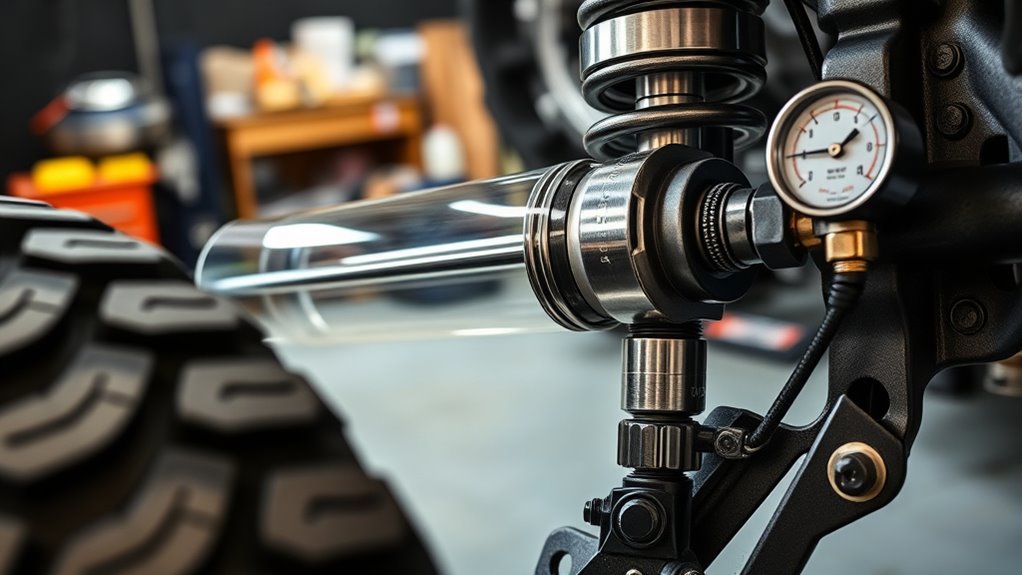
You’ll notice that the air pressure inside the shock acts like a cushion, supporting your vehicle’s weight as you drive. When the load changes, the air adapts by compressing more or less to keep the ride smooth and level. This dynamic adjustment helps maintain comfort and stability, no matter the terrain or cargo.
Air Pressure Cushioning
When your vehicle rolls over bumps or uneven terrain, the air pressure inside the shock’s chamber compresses to absorb the impact. This air pressure cushioning plays a crucial role in impact absorption and maintaining ride comfort. Here’s how it works:
- The shock chamber fills with pressurized air that acts like a spring.
- As the wheel hits a bump, the air compresses, cushioning the force.
- Increased air pressure makes the suspension firmer, supporting heavier weight.
- Lower pressure softens the ride, enhancing comfort on rough roads.
Load Adaptation Mechanism
Although the terrain and load constantly change, air shocks adjust by increasing or decreasing air pressure inside the chamber. This load adaptation mechanism uses system regulation, either sensors or manual controls, to maintain the proper air pressure.
That way, it supports the vehicle’s weight and preserves ride height. When the load increases, air pressure rises, stiffening the suspension and resisting compression. Conversely, with less load or smooth terrain, air pressure drops, softening the ride.
| Load Condition | Air Pressure Level | Suspension Response |
|---|---|---|
| Heavy Load | High | Firm, resists compression |
| Medium Load | Moderate | Balanced support |
| Light Load | Low | Softer, smoother ride |
| Unloaded | Minimal | Maximum softness |
This dynamic adjustment ensures air shocks evenly distribute weight for ideal performance.
How Air Is Pumped Into the Shock Chamber
Because the shock chamber needs precise air pressure to perform effectively, air is pumped in through an intake valve linked to a portable compressor or the vehicle’s onboard system. This process guarantees the shock chamber maintains the right firmness and ride height. Here’s how it works:
- The intake valve opens, allowing compressed air from a compressor to enter the sealed shock chamber.
- The onboard compressor automatically activates when sensors detect a need for ride height adjustment or extra support.
- Compressed air increases the air pressure inside the shock chamber to the desired level.
- Once the target air pressure is reached, the intake valve closes to keep the pressure steady within the shock chamber.
How Air Shocks Control Air Flow and Pressure
After air is pumped into the shock chamber to reach the right pressure, the system must carefully manage that air to keep your ride smooth and stable. Valves, controlled by the electronic control unit (ECU), regulate air flow precisely.
The ECU receives sensor input detecting changes in terrain or compression and adjusts the valves accordingly. When the vehicle hits a bump, sensors signal the ECU to release or add air pressure by opening or closing solenoid valves.
The compressor then refills or reduces air to maintain the set pressure, ensuring consistent suspension firmness.
| Component | Role | Control Method |
|---|---|---|
| Valves | Regulate air flow | ECU-operated solenoids |
| Sensor Input | Detects compression changes | Sends data to ECU |
| Electronic Control Unit | Manages valves & compressor | Processes sensor input |
| Compressor | Maintains air pressure | Activated by ECU |
This dynamic system balances air pressure and flow to adapt instantly for a comfortable ride.
How Dampers Control Compression and Rebound
While air shocks rely on air pressure to absorb impacts, dampers control compression and rebound by managing hydraulic fluid flow inside the shock. You’ll find valves inside the dampers that adjust how this fluid moves, directly affecting how the shock responds to road conditions.
Here’s how dampers manage compression and rebound:
- During compression, valves restrict hydraulic fluid flow, softening impacts and preventing harsh jolts.
- When rebounding, valves control fluid flow to slow piston extension, reducing bouncing.
- The balance between compression and rebound damping keeps your ride stable and comfortable.
- Adjustable valves let you fine-tune the damping for different loads and driving styles.
How Adjusting Air Pressure Changes Ride Firmness
When you adjust the air pressure inside your shock, you’re directly changing how firm or soft the ride feels. If you increase the pressure, the suspension gets stiffer. On the other hand, lowering the pressure allows the shock to absorb bumps more smoothly.
It’s a simple tweak, but it makes a big difference. You can fine-tune the ride quality to match your load, the terrain, and what feels best to you.
Impact of Air Pressure
How does adjusting the air pressure inside your shock affect your ride? By changing the air pressure, you directly influence how your suspension performs. When you adjust the air pressure in the shock components, you’re effectively controlling the firmness and responsiveness of your ride.
This adjustment impacts ride height and the suspension’s ability to absorb bumps.
Here’s how air pressure affects your ride:
- Increasing air pressure firms up the air spring, making the ride stiffer.
- Decreasing air pressure softens the suspension for a smoother feel.
- Higher air pressure helps maintain ride height under heavy loads.
- Lower air pressure allows greater wheel travel, improving comfort over rough terrain.
Adjusting air pressure lets you fine-tune your suspension to fit specific driving needs.
Firmness Adjustment Mechanism
Adjusting the air pressure inside your shock’s chamber changes the ride firmness by altering how much the air compresses. When you increase air pressure, the system stiffens the suspension, raising firmness and support.
Lowering air pressure lets the air expand, softening the ride for more comfort. This adjustment directly affects the spring rate, balancing firmness to match your preferences or load.
The air shocks system uses valves and pumps to fine-tune pressure, while an electronic control unit maintains the set firmness and ride height automatically.
| Air Pressure Level | Resulting Firmness |
|---|---|
| High | Stiffer suspension |
| Medium | Balanced firmness |
| Low | Softer ride |
Ride Quality Variations
Why does changing air pressure inside your shocks impact ride quality so much? It all boils down to how air pressure affects the shock components, especially the spring rate. Adjusting air pressure directly changes how stiff or soft your suspension feels, influencing ride comfort and suspension travel.
Here’s what happens:
- Increasing air pressure raises the spring rate, making the suspension firmer.
- Firmer shocks resist compression more, reducing body roll and bounce.
- Decreasing air pressure lowers the spring rate, softening the ride.
- Softer shocks allow more suspension travel, improving cushioning over bumps.
How Air Shock Sensors and Control Units Automate Adjustments
Because air shock sensors constantly track your vehicle’s height and load, they provide real-time data to the control unit, which then decides if your air springs need adjusting. These air shock sensors measure changes in ride height and load conditions precisely, sending continuous feedback to electronic control units.
Air shock sensors continuously monitor vehicle height and load, sending real-time data to control units for precise air spring adjustments.
The control units analyze this data against preset parameters to maintain consistent ride height regulation. When adjustments are necessary, the control unit triggers automated adjustments by activating compressors or air valves to regulate air pressure accordingly.
This process happens seamlessly without any input from you, ensuring that your vehicle maintains ideal ride height and stability at all times. By automating air pressure regulation, the system adapts quickly to changes in terrain, weight, or driving conditions, delivering a smoother and more comfortable ride.
With this technology, ride quality improves while vehicle handling remains stable, all thanks to the precise coordination between air shock sensors and control units.
How Air Shocks Inflate and Deflate: A Step-by-Step Guide
The system doesn’t just monitor your vehicle’s height and load. It actively manages air pressure to keep your ride smooth. Air shocks inflate and deflate through pneumatic valves controlled by sensors or electronic modules. These adjust to your driving conditions automatically or manually.
Here’s how the process works step-by-step:
- Sensors detect the need for adjustment based on load or terrain.
- The control unit signals the compressor to inflate or deflate the air shocks.
- To inflate, compressed air is sent through hoses to the air spring chamber, raising ride height and stiffness.
- To deflate, pneumatic valves open, releasing air pressure to lower the vehicle or soften suspension.
This precise control of air pressure lets your air shocks maintain the best comfort and handling by responding instantly to changing conditions. It ensures a balanced, smooth ride every time you drive.
Common Signs of Air Shock Problems
When your air shocks start to lose pressure or fail, you’ll notice your vehicle sagging or leaning to one side due to a vehicle sag caused by air leaks. These leaks reduce air pressure, preventing the shocks from supporting your suspension properly.
You might also hear unusual compressor noise, like hissing or persistent whines, signaling the compressor is working harder to compensate for lost pressure. If your ride feels bumpier or rougher than usual, it’s a clear sign your air shocks aren’t absorbing impacts effectively, which often stems from suspension problems.
Another common symptom is inconsistent ride height or visible sagging even after adjustments, indicating worn or damaged components. When the compressor runs continuously or more frequently, it’s trying to maintain proper air pressure but struggles because of leaks or failing parts.
Recognizing these signs early helps you address air shock issues before they worsen or affect your vehicle’s safety.
How to Maintain and Tune Air Shocks
Noticing signs of air shock problems means it’s time to focus on maintaining and tuning your system to keep it performing smoothly. Proper maintenance and adjusting suspension settings guarantee your ride stays comfortable and responsive. Here’s how you can maintain and tune your air shocks effectively:
- Regularly check and adjust the air pressure with a compressor or pump to maintain ideal ride height and performance.
- Inspect air lines, seals, and valves for leaks or damage, replacing any worn parts immediately to avoid system failure.
- Use system diagnostics via your vehicle’s onboard controls or external tools to identify issues early and fine-tune damping settings based on driving conditions.
- Clean and service the compressor and air tank regularly to prevent moisture buildup and maintain a consistent air supply.
Following these steps helps prolong your air shocks’ life and keeps your suspension system responsive and safe.
Frequently Asked Questions
Can Air Shocks Improve Fuel Efficiency?
Yes, air shocks can improve fuel efficiency by providing fuel savings through aerodynamic improvements and weight reduction. When you keep your air shocks properly inflated, they help optimize ride height, reducing drag and enhancing engine efficiency.
This also prevents uneven tire wear, so your tires last longer and roll more smoothly. By maintaining your air shocks well, you’ll enjoy better fuel economy and a more efficient, comfortable ride overall.
Are Air Shocks Compatible With All Vehicle Types?
You might wish air shocks were compatible with every vehicle out there, but sadly, they’re not. Suspension compatibility depends on your vehicle’s weight, load capacity, and shock absorber types.
Air shocks thrive in heavy-duty trucks with adjustable mechanisms, but they don’t fit neatly into every ride. If your car’s suspension wasn’t designed for them, you’ll need mods or custom brackets.
How Do Air Shocks Perform in Extreme Weather Conditions?
In extreme temperature effects, your air shocks might lose pressure as air contracts, reducing support and ride height. Moisture impact can cause freezing issues inside air lines or compressors, leading to blockages.
To keep material durability and corrosion resistance high, you need regular maintenance and moisture separators. These steps help prevent damage and guarantee your shocks perform reliably, even when harsh weather tries to compromise their function.
What Is the Average Lifespan of Air Shocks?
You can expect the average lifespan of air shocks to be between 50,000 and 100,000 miles. Proper air shock maintenance, like regular pressure checks and inspections, helps prolong their life.
When you notice decreased ride comfort or signs of wear, it’s time for air shock replacement. Different shock absorber types vary, but keeping your suspension system in top shape ensures better performance and longevity for your air shocks.
Can Air Shocks Be Installed as a DIY Project?
Yes, you can install air shocks as a DIY project, but expect a 25% higher chance of installation challenges without professional help. You’ll need specific tools like wrenches, a jack, and possibly a spring compressor.
Safety precautions are vital to avoid injury and leaks. Installation cost can be lower DIY, but watch for compatibility issues with your vehicle’s suspension. If unsure, consulting a pro is wise to confirm everything fits and works correctly.
Conclusion
Think of air shocks as the invisible guardians of your ride, softly cushioning every bump like a gentle breath of wind. They adapt, absorb, and support, turning rough roads into smooth journeys.
By understanding their inner workings, you hold the key to keeping your vehicle balanced and comfortable. Just like tending a delicate garden, maintaining your air shocks guarantees they continue to bloom with performance, giving you control and confidence on every path you take.